
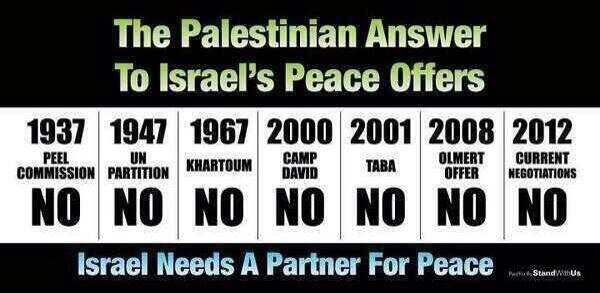
Showing posts with label "No" is the real obstacle to peace. Show all posts
Showing posts with label "No" is the real obstacle to peace. Show all posts
Monday, January 6, 2014
Thursday, November 17, 2011

Wednesday, November 2, 2011
There's no hope for peace
 Two days ago, I showed you a video in which 'moderate' 'Palestinian' President
 Peter Wehner sums up what that video taught those of us who were willing to watch it and accept it at face value (which likely includes no one in Obama's Washington).
We’re repeatedly told that the issues surrounding the Israeli-Palestinian conflict are enormously complicated, solvable only by diplomats of unusual skill and ability, and that Israel, always Israel, must take a “chance for peace.” But in its most important respects this conflict, at its core, is quite simple: the Palestinians have yet to make their own inner peace with the existence of a Jewish state. Every failed effort at peace, beginning before Oslo and to this very day, can be traced back to this fundamental truth. Because it is an unpleasant one, many people in the West have simply refused to accept it. It is too unsettling to their premises and presuppositions. And so they proceed in self-deception, demanding that Israel make concessions with a “peace partner” that is, in fact, an implacable and lethal enemy.It's time to dispel our illusions. There is no peace on the way. Not now, and probably not ever.
Tactically “we may win or lose,” Faisal Husseini, a supposedly moderate figure in Yasir Arafat’s Palestinian Authority, said a decade ago. “But our yes will continue to aspire to the strategic goal, namely, to Palestine from the [Jordan] rive to the [Mediterranean] sea.”
“Whatever we get now,” he added, “cannot make us forget this supreme truth.”
That remains, now as ever, the “supreme truth” guiding the Palestinian leadership. As long as it does–as long as the malignant and murderous pathologies that afflict the Palestinian and Arab world remain–it is folly to pretend real peace is possible. Illusions, even soothing illusions, are never a substitute for reality.


The Problem Is Palestinian Rejectionism Why the PA Must Recognize a Jewish State Yosef Kuperwasser and Shalom Lipner
Nearly two decades of peace negotiations between Israel and the Palestinians have failed miserably. The key reason for this failure is the Palestinians’ refusal to recognize Israel as a Jewish state.
The basic paradigm of the Oslo accords, signed in 1993, held that both the Israelis and the Palestinians were, at long last, prepared to recognize the legitimacy of each other’s national rights and aspirations. With that essential threshold crossed, it was thought, all that would remain was to work out a compromise on core issues: where to draw borders, whether and how to divide Jerusalem, and how to resolve the Palestinian demand that refugees from the 1948 war be allowed to return to Israel.
 That, at least, was the theory. Yet over the course of the last 18 years, during which negotiations were conducted along these lines, the rhetoric and actions of the Palestinian leadership have proved that paradigm wrong. The Palestinians have not in fact recognized the legitimacy of the national rights of the Jewish people. Consider, for example, the Palestinians’ refusal to negotiate with Israel over the past year, a result, they say, of continued settlement construction in Jerusalem and beyond the 1967 lines. This is a dubious claim given that the Palestinians have never made halting construction a precondition before. And when Israel did freeze settlement building for ten months in 2009–10, the Palestinians still refused to talk, only agreeing to do so at the last moment and even then only to prevent a crisis in their relations with the United States....
Tuesday, November 1, 2011
Abu Mazen says he'll never recognize a Jewish state, kidnapping Shalit a good thing
 Last week, our 'peace partner,' 'moderate' 'Palestinian' President
Here's a transcript.
Mahmoud Abbas: "First of all, let me make something clear about the story of the 'Jewish state.'You can watch the video here.
"They started talking to me about the 'Jewish state' only two years ago, discussing it with me at every opportunity, every forum I went to – Jewish or non-Jewish – asking: 'What do you think about the "Jewish state"?' I've said it before, and I'll say it again: I will never recognize the Jewishness of the state, or a 'Jewish state.'" [...]
Interviewer: "Don't you think that it was the resistance that managed to liberate a thousand prisoners?
"Negotiations must always be accompanied by a measure of force. There can be no negotiations without resistance. This has been shown by the experience of people – in Ireland and all countries."
Mahmoud Abbas: "That's true, but our circumstances are different. We are not able to wage military resistance.
"Hamas kidnapped – or rather, captured – a soldier, and managed to keep him for five years, and that is a good thing.
"We don't deny it. On the contrary, it’s a good thing that on a small strip of land, 40 × 7 kilometers, they were able to keep him and hide him." [...]
Friday, September 23, 2011
SWC: Abbas' View of History Has No Room for Jewish Prophets or Kings; His View of Reality Has No Room for a Jewish State On the day he submitted demands for Palestinian Statehood, Abbas' words have driven hope for peace right off the Mideast roadmap
"Abbas' speech provides all the evidence as to why there is no peace. His distorted view of history of the Holy Land, speaks of "the ascension of the Prophet Mohammad and the birthplace of Jesus Christ," but has no room for Jewish prophets like Isaiah or Jeremiah or King David or King Solomon," charged Rabbis Marvin Hier and Abraham Cooper, Founder and Dean and Associate Dean of the leading Jewish Human Rights NGO.
"And when President Abbas uses the podium of the United Nations to charge that Arabs have been under occupation for 63 years, he lays bare before the entire world that the core issue for the Palestinians isn't Israeli settlements established as a result of the 1967 Six Day War, but the very legitimacy of Israel from the day of its founding in 1948. Simply put his view of reality has no room for a Jewish state," Center officials added.
"Unless and until Arab leaders finally tell their people that they recognize the legitimacy of a Jewish State as neighbor to the 23 Arab countries there will be no peace," Rabbi Hier and Cooper concluded.
The Wiesenthal Center has launched a 30-second spot on CNN and FOX News around the United States and CITY TV in Toronto and virally on YouTube calling on the Arab World to recognize Israel as a Jewish State.
To view please go to: http://www.youtube.com/watch?v=QJARFGAX_a4
The Simon Wiesenthal Center is one of the largest international Jewish human rights organizations with over 400,000 member families in the United States. It is an NGO at international agencies including the United Nations, UNESCO, the OSCE, the OAS, the Council of Europe and the Latin American Parliament (Parlatino).
Wednesday, September 21, 2011
Debunking the Palestine Lie
Palestinian President Mahmoud Abbas has launched an international campaign to achieve recognition by the United Nations for an independent Palestinian state. Abbas and his international supporters claim that only Israel (with the United States) stands in the way of this act of historical justice, which would finally bring about peace in the Middle East.
This video debunks the Palestinians' claim and shows that Abbas has been lying about the origins and history of the conflict. Palestinian leaders have rejected partition plans that would have given them much more land for their independent state than the Jews were offered for theirs. Rather than being the innocent victims of a "dispossession" at the hands of the Israelis, the Palestinians rejected reasonable compromises and instead pursued their aim of getting rid of the only Jewish state in the world.
Tuesday, September 20, 2011
Washington Post: Abbas Not Serious for PA State
The influential Washington Post has accused Mahmoud Abbas of not being serious about wanting to establish the Palestinian Authority as a country.
In a lead editorial Tuesday morning, the liberal newspaper joined a growing number of mainstream media outlets – with the notable exception of The New York Times – throwing up their hands at Abbas’ constant rebuffs to the “peace process.”
The editorial noted that Abbas on Monday admitted that Palestinian Authority Arabs face hard times because of his tactic of asking the United Nations for unilateral recognition instead of returning to negotiations with Israel.
“Congress may terminate U.S. aid, causing an instant economic crisis,” the newspaper’s editors wrote. "Israel is hinting at retaliation, ranging from the withholding of tax funds to the annexation of its West Bank settlements. At worst, demonstrations being orchestrated by Mr. Abbas to support the statehood initiative will get out of hand, producing a violent confrontation with Israel.”
The Washington Post stated that Prime Minister Binyamin Netanyahu has accepted President Barack Obama’s policy, which basically mirrors that of Abbas, to reach an agreement based on the temporary 1949 Armistice Lines, commonly known as the “1967 borders” but also called the ”Auschwitz borders” by critics.
“Were he serious about achieving statehood, Mr. Abbas would seize on that point — which he defined as critical just months ago — and proceed with negotiations about drawing a border,” the editorial concluded. “Instead, he appears likely to stick with his grand gesture — and to let Palestinians pay the price.”
Other newspapers also have strongly editorialized against Abbas for burying the American-sponsored diplomatic process, which began in Madrid in 1991.
“The U.S. should honor its promise to veto any effort in the U.N. to unilaterally recognize an independent Palestinian state and thereby short-circuit a negotiated peace, which is the only path to long-term stability in the region,” an editorial in theBaltimore Sun stated Tuesday morning.
The Tuscaloosa Alabama News called the Abbas’ move to the United Nations “a foolhardy gambit” that “may be a short-lived diplomatic coup, but the result will be more hardship for Palestinians and more retrenchment along the hard lines of negotiation.”
Another negative editorial on Abbas was printed in the Boston Phoenix, which wrote, "The Palestinian Authority is in the midst of staging a hollow piece of political theater that will boomerang. By unrealistically raising the hopes of the people it purports to represent, the Authority will not fail only to change any facts on the ground, but sadly move the possibility of a workable peace beyond any visible horizon.”
The New York Times has taken an increasingly anti-Israel stand, blaming Israel and President Barack Obama for not accepting Abbas’ conditions for establishing the Palestinian Authority as a country within Israel’s borders.
Sunday, September 18, 2011

Perry: Palestinians Must Recognize Israel as a Jewish State
Texas Governor and GOP presidential hopeful Rick Perry wrote an op-ed taking the Palestinians to the woodshed for their plans to seek UN recognition of a Palestinian state. He also admonished President Obama for distancing himself from Israel while pursuing engagement with Iran and Syria. While the Obama Administration has been notable for exerting pressure on Israel, a Perry Administration would put the pressure where it belongs:
The United States must affirm that the precondition for any properly negotiated settlement between Israel and the Palestinian Authority is the formal recognition of the right of Israel to exist as a Jewish state behind secure borders.
Now I have no illusions that the Palestinian Authority is prepared to do such a thing. They don't want to live side by side in peace with Israel. But if Perry wins the GOP nomination, is elected President and somehow finds a way to get the Palestinians to recognize Israel as a Jewish state, it would be the greatest foreign policy achievement of his presidency. But even if that doesn't come to pass, at the very least a Perry Administration would hold the Palestinians accountable for their actions in a way the Obama Administration simply won't.

Thursday, June 2, 2011
'Fatah has never recognized Israel and will never do so' By KHALED ABU TOAMEH 01/06/2011 Central C'tee member, close to Abbas says only governments recognize each other, not political parties; praises Hamas leader's speech.

Ahmed, who is also head of the Fatah negotiating team with Hamas, said PA security forces in the West Bank were arresting Hamas supporters to protect them from being targeted by the IDF.
Ahmed’s remarks were made in an interview with the Egyptian newspaper Al-Masry Al- Youm.
Asked whether Fatah had spoken with Hamas about recognizing Israel, the senior Fatah official said, “Fatah has not recognized Israel. I challenge anyone who says that the case is otherwise, whether it’s Hamas or others. Neither Fatah nor Hamas is required to recognize Israel. Only governments and states extend recognition. It was the Palestinian government that recognized Israel, just as the Israeli government recognized us.”
Ahmed said the PLO had recognized Israel with the signing of the Oslo Accords.
“An organization recognized a state and a state recognized an organization,” he said.
“Now states should recognize each other when a Palestinian state is declared next September.”
In response to allegations that PA security forces have been cracking down on Hamas supporters in the West Bank, Ahmed said, “We in Fatah arrest Hamas members to protect them from Israel or from family disputes.”
The Fatah official praised Hamas chief Khaled Mashaal for delivering a “wonderful” speech during the signing ceremony for the Egyptian-brokered Fatah-Hamas reconciliation accord in Cairo on May 4.
“Mashaal used political language like President Abbas,” he added. “He talked about a Palestinian state on the 1967 borders and said that he would give political efforts and negotiations a chance. Therefore, I consider this speech to be responsible.”
Ahmed said the new PA unity government, which would be established in accordance with the reconciliation pact, would not deal with peace talks with Israel.
“The PLO is in charge of the negotiations,” he emphasized.
“Hamas will join the PLO Executive Committee and become part of the PLO.”
He said he was happy to see Egyptians demonstrating outside the Israeli Embassy in Cairo in the aftermath of the departure of the regime of Hosni Mubarak.
“When I see the demonstrations surrounding the Israeli Embassy in Cairo, I feel optimistic and that, as a Palestinian, I have received a new weapon and pressure force,” Ahmed said.
“This is a new change and we have seen how the Israelis are worried about these demonstrations.”
Tuesday, March 22, 2011
So it wasn't Israel; Arab gov'ts were real problem
In the great Middle East who dunit, the verdict is in: The Jews are innocent. They aren't responsible for the violence, extremism, backwardness, discontent or predatory government of their Arab neighbors.
The last few months should have finally shattered the persistent illusion that the Israeli-Palestinian question determines all in the Middle East.
In an essay in Foreign Policy magazine titled "The False Religion of Mideast Peace," ex-diplomat Aaron David Miller
recounts the conventional wisdom running back through the Cold War: "An unresolved Arab-Israeli conflict would trigger ruinous war, increase Soviet influence, weaken Arab moderates, strengthen Arab radicals, jeopardize access to Middle East oil, and generally undermine US influence from Rabat to Karachi."
Behind these assumptions has long stood a deeply simplistic understanding of the Arabs. Professional naif Jimmy Carter insists, "There is no doubt: The heart and mind of every Muslim is affected by whether or not the Israeli-Palestinian issue is dealt with fairly."
This is reductive to the point of insult. Carter thinks that Muslims have no interior lives of their own, but are all defined by a foreign-policy dispute that is unlikely to affect most of them directly in the least. He mistakes real people for participants in an endless Council on Foreign Relations seminar.
The Israeli-Palestinian issue certainly has great emotional charge, and most Arabs would prefer a world blissfully free of the Zionist entity. But the Israelis can't be blamed -- though cynical Arab governments certainly try -- for unemployment and repression in Arab countries.
Monumental events in recent decades -- the Iranian revolution, the Iran-Iraq War and the Iraqi invasion of Kuwait -- were driven by internal Muslim confessional, ideological and geo-political differences. Israel has nothing to do with the Sunnis hating the Shia, or the Saudis hating the Iranians, or everyone hating Moammar Khadafy.
Adam Garfinkle muses in his book "Jewcentricity": "Imagine, if you can, that one day Israelis decided to pack their bags and move away, giving the country to the Palestinians with a check for sixty years' rent. Would the Arabs suddenly stop competing among themselves, and would America and the Arab world suddenly fall in love with each other?"
Yet the pull of the illusion is so powerful that even those who don't profess to believe in it, like George W. Bush, eventually get sucked in. Barack Obama came into office ready to deploy his charm and fulfill the millennial promise of the peace process once and for all. He couldn't even get the Palestinians to sit down to negotiate with the Israelis, in an unintended "reset" to the situation decades ago.
According to the illusion, the region should have exploded in rage at Jewish perfidy and American ineffectualness. It exploded for altogether different reasons.
We witnessed revolutions in Tunisia and Egypt without a hint of upset at the Israeli settlements or America's continued failure as a broker of peace. We've seen the Arab League petition the United States -- whose sole function is supposed to be monitoring Israeli housing developments and paving the way for a Palestinian state -- to undertake a military operation against another (recently suspended) member of the Arab League, Libya.
It'd be easier if the key to the Middle East really were sitting around a negotiating table with a couple of bottles of Evian, poring over a map adjudicating a dispute so familiar that people have built diplomatic, academic and journalistic careers on it.
The current terrain of the Middle East as it exists -- not as we assume it should be -- is hellishly disorienting by comparison: What to do when an ally invades another ally to knock around protesters in violation of our values? When a tin-pot dictator thumbs his nose at us and the rest of West and crushes his opponents with alacrity despite our earnest protestations? When popular uprisings threaten our allies more than our enemies?
It makes the old peace process seem alluringly comfortable and manageable. No, the illusion will never die.
Monday, March 21, 2011
What if Arabs had recognized the State of Israel in 1948? By ABDULATEEF AL-MULHIM
I HAVE been exposed to Palestinians since I was in first grade in Al-Hassa, Saudi Arabia They were my favorite teachers. They were the most dedicated and the most intelligent among all my instructors, from elementary to high school.
When I was attending New York-based SUNY Maritime college (1975-1979), I read a lot of books about Palestinians, Arabs and the Israelis. I have read every article about the many chances the Palestinians had and missed to solve their problem, especially the Camp David agreement between Egypt and Israel.
I have seen and read about the lives of the Palestinians in the US and other places. They are very successful in every field. And at the same time I saw the Arab countries at the bottom of the list in education and development. And I always ask the question: What if the Palestinians and the Arabs accepted the presence of Israel on May 14, 1948 and recognized its right to exist? Would the Arab world have been more stable, more democratic and more advanced?
If Israel was recognized in 1948, then the Palestinians would have been able to free themselves from the hollow promises of some Arab dictators who kept telling them that the refugees would be back in their homes and all Arab lands will be liberated and Israel will be sent to the bottom of the sea. Some Arab leaders used the Palestinians for their own agenda to suppress their own people and to stay in power.
Since 1948, if an Arab politician wanted to be the hero and the leader of the Arab world, then he has a very easy way to do it. He just shouts as loud as he can about the intention to destroy Israel, without mobilizing one soldier (Talk is cheap).
If Israel was recognized in 1948, then there would have been no need for a coup in Egypt against King Farouq in 1952 and there would have been no attack on Egypt in 1956 by The UK, France and Israel. Also there will be no war in June 1967 and the size of Israel will not be increased and we, the Arabs would not have the need for a UN resolution to beg Israel to go back to the pre-1967 borders. And no war of attrition between Egypt and Israel that caused more casualties on the Egyptian side than the Israeli side.
After the 1967 war, Israel became a strategic ally of the US because before this war, the US was not as close to Israel as people in the Arab world think. The Israelis fought in that war using mainly French and British weapons. At that time, the US administrations refused to supply Israel with more modern aircraft and weapon systems such as the F-4 Phantom.
The Palestinian misery was also used to topple another stable monarchy, this time in Iraq and replacing it with a bloody dictatorship in one of the richest countries of the world. Iraq is rich in minerals, water reserves, fertile land and archaeological sites. The military led by Abdul Karim Qassim killed King Faisal II and his family. Bloodshed in Iraq continued and this Arab country has seen more violent revolutions and one of them was carried out in the 1960s by a brigade that was sent to help liberate Palestine. Instead it made a turn and went back and took over Baghdad. Even years later, Saddam Hussien said that he will liberate Jerusalem via Kuwait. He used Palestinians misery as an excuse to invade Kuwait.
If Israel were recognized in 1948, then the 1968 coup would not have taken place in another stable and rich monarchy (Kingdom of Libya). King Idris was toppled and Muammar Qaddafi took over.
There were other military coups in the Arab world such as Syria, Yemen and the Sudan. And each one of them used Palestine as their reason for such acts. The Egyptian regime of Jamal Abdul Nasser used to call the Arab Gulf states backward states and he tried to topple the governments of these Gulf states by using his media and his military forces. He even attacked southern borders of Saudi Arabia using his air force bases in Yemen.
Even a non-Arab country (Iran) used Palestine to divert the minds of their people from internal unrest. I remember Ayatollah Khomeini declaring that he would liberate Jerusalem via Baghdad and President Ahmadinejad making bellicose statements about Israel, though not even a single fire cracker was fired from Iran toward Israel.
Now, the Palestinians are on their own. Each Arab country is busy with its own crisis. From Egypt, Tunisia, Libya, Sudan, Yemen, Syria, Jordan, Somalia, Algeria, Lebanon and the Gulf states. For now, the Arab countries have put the Palestinian-Israeli conflict on hold.
—Abdulateef Al-Mulhim, is Commodore (Retd.), Royal Saudi Navy. He is based in Alkhobar, Saudi Arabia, and can be contacted at: almulhimnavy@hotmail.com
Sunday, March 20, 2011
One of the Big Flaws in Obama's Middle East Policy: Islamists Don't Want to be His Pals
When Muhamad ElBaradei tried to vote March 19 in the referendum on Egypt's constitutional changes, he was attacked by hundreds of Islamists with stones, at least one of which hit him, and shoes. "We don't want you," the mob shouted. "He lives in the United States and wants to rule us. It's out of the question," one demonstrator said.
"We don't want an American agent," said another. ElBaradei ran away without voting.
Just five weeks after President Barack Obama helped overthrow the Egyptian regime, accompanied by endless media reports about how great and democratic this was all going to be, and after we were told by scores of instant "experts" that the Muslim Brotherhood was weak and harmless, Egypt is beginning to reap the whirlwind.
Why should anyone be surprised? This statement from Rashad Bayoumi, the Egyptian Muslim Brotherhood's number-two leader, as translated by MEMRI, should trigger memories:
"The thing I fear most is foreign intervention. Our people and societies must realize that their main enemy abroad is the U.S. and the Zionist gang, and that their main enemy within is Israel. Everybody must take this into account, and must be aware that this is the enemy that lurks in the midst of Middle Eastern society. This must be clear to everybody."
My thoughts flew back to 1979. After the Iranian Islamist revolution, which took power the previous February, the administration of President Jimmy Carter did everything possible to assure the new regime of American friendship. But the more the U.S. government tried to engage them, the more suspicious Iran's new leaders became.
Why? Because they understood that the U.S. goal was to moderate the revolution, which is precisely what they didn't want to happen. The last straw was when National Security Advisor Zbigniew Brzezinski met with Iranian Prime Minister Mehdi Bazargan, the moderate front man for the regime. This was seen in Tehran as a dire threat and led directly to the seizure of the U.S. embassy and the taking of the Americans there as hostages.
So Bayoumi's words remind us that the closer the Americans try to get to the Islamists--to prove that the United States is their good buddy--the more they fear "foreign intervention" and feel the need to express their anti-Americanism.
It also reminds us, of course, that Israel is the number-one obsession of the Brotherhood and they are sure to try to implement their plan for attacking and if possible destroying it.
But America can't make friends with revolutionary Islamists because:
--They hate America because they have an ideological view of it as the enemy. And they're right in doing so because the United States will not ultimately support and help them achieve their goals.
--They want to keep their distance because they correctly believe America will help strengthen moderate non-Islamists against them.
--They want to keep their distance because they correctly believe America will try to help and strengthen the most relatively moderate tendencies among Islamists, thus coopting them and destroying their movement.
--They wish to push America away to prove to each other and their rivals that they are not American agents.
There are two ways for the United States to understand this: the hard way and the easy way. The easy way is to understand the history, ideology, and behavior of the Islamists.
The hard way is to ignore all of the evidence and experience, create catastrophic situations, and only then wake up and try to repair the damage done by their own policies.
I think U.S. policy is doing this the hard way.
Sunday, March 6, 2011
YNET: Arabs don’t want 2 states Facts speak for themselves: Arabs don’t accept vision of two sovereign states
Twenty five years after the British gave away 76% of the land they promised as a homeland for the Jewish people the United Nations voted to partition the remaining 24% into two states, one Arab, one Jewish. This gave the Jews a mere 12% of what they were originally promised. Nevertheless, the Jews said “yes” to the deal.
The Arab answer was an ominous “no.” One day after Israel declared independence the Arabs attacked intending to destroy it.
And what are the Arabs offering? In a word, nothing. Unless you consider their vague promises and poor track record on curbing terror as enough.
The repeated Arab failure to live up to promises of curbing terror forced Israel to take the matter into its own hands by constructing the security barrier. This has proven to be a highly effective deterrent, saving untold innocent lives. Since its construction terror attacks from these areas have been all but eliminated.
Does Hamas support a two-state solution? Group leader Khaled Mashaal said “has not and will not recognize Israel.” Hamas’ charter calls for Israel’s destruction. This puts them in the “no” column. Mahmoud Abbas is already on record refusing to accept Israel as a Jewish state. His party’s constitution likewise calls for the destruction of Israel. This puts Fatah in the “no” column.
So who supports a two-state solution?
In spite of undeniable evidence to the contrary, the prevailing opinion of President Obama and most western leaders is that Abbas supports a two-state solution. But is this really the case?
His precise quote when asked if he would accept Israel as a Jewish state was “I do not accept it.”
He attends mosques where vitriolic sermons are spoken, blaming the Jews for all the Muslim’s problems, suggesting the only course of action is “jihad” against the “Zionist entity.” He routinely attends events where the map of Israel is completely covered by a Palestinian flag. He names public squares after suicide bombers who murdered innocent Israeli civilians.
His continued demand the so-called “refugees” be allowed to flood into Israel, would eliminate its Jewish majority. Yet isn’t the intent of a two-state solution based on two distinct sovereign states, one of which is Jewish?
Former Israeli PM Ehud Barack was willing to give up over 90% of Judea/Samaria and divide Jerusalem in 2000 at the Camp David ll negotiations.
Under PM Ehud Olmert, Israel offered approximately 98% of Judea/Samaria, land swaps and a divided Jerusalem. Abbas dismissed Olmert’s offer, yet he recently told US Envoy George Mitchell, “the points agreed upon with Olmert are agreements with the government of Israel.” Apparently, he’s creating his own rules of diplomatic negotiations now.
Lest we forget a key reason why Hamas and Fatah have been at odds with each other, and what motivated Hamas to violently take over Gaza in 2007: Namely, Fatah’s talks with Israel, which in the mind of Hamas leaders suggests Fatah has given “legitimacy” to Israel. This is completely unacceptable to Hamas to the point of being blasphemous.
The only two-state “solution” the Muslims may truly endorse is one state controlled by Fatah and the other by Hamas…once Israel has been eliminated.
Yet here we are more than 60 years later and we are led to believe the answer to the conflict is another two-state “solution,” albeit with the land sacrifices coming from only one side - Israel.
Another matter Israel took upon itself was a voluntary withdrawal from the Gaza Strip in 2005. The “thank you” it received was approximately 8,000 rocket and mortar attacks until it finally had to take action against Hamas in Jan. ’09.
Abbas creating new rules
The facts speak for themselves: He is on record denying any Jewish connection to Jerusalem, saying “I challenge this claim is so.” His demands include making Jerusalem the capital of “Palestine,” thus all Jewish connection to the holy Old City would vanish, leaving Jews without access to their two holiest sites, Temple Mount and the Western Wall.The Arab answer? “No.”
While Presidents Bush, Obama and many other world leaders have endorsed a two-state solution, what these same leaders don’t appear to understand is that key Arab players don’t. Some believe Abbas might accept a two-state solution, but only as a first step toward the ultimate elimination of Israel.
Tuesday, March 1, 2011
The 'Israel First' Myth Obsessed with the Jewish state, Mideast "experts" got the region all wrong.

In the past few weeks, we've seen revolutions in Egypt and Tunisia, a brutal and continuing attempt to put down a rebellion in Libya, and varying degrees of unrest, sometimes violent, in Algeria, Bahrain, Djibouti, Iran, Iraq, Jordan, Kuwait, Lebanon, Mauritania, Morocco, Oman, Sudan and Yemen.
If only Israel would recognize a Palestinian state, we would have peace in the Middle East!
Ha ha. Hardly anybody is saying that now, but it's worth remembering that it has been the accepted view among Mideast "experts" for decades. Israeli cartoonist Yaakov Kirschen, who draws the syndicated Dry Bones strip, had a terrific one a few weeks ago. It showed a pair of such experts yammering, "Israel, Palestine, Gaza, Israel, Palestine, Gaza," ad nauseam. In the second panel, the experts are shaken as a voice yells "EGYPT!" In the third panel, they stand silently, trying to make sense of it all.
Nick Cohen of London's Observer, a rare British leftist who does not loathe Israel, confronts his ideological brethren in an excellent column:
To a generation of politically active if not morally consistent campaigners, the Middle East has meant Israel and only Israel. In theory, they should have been able to stick by universal principles and support a just settlement for the Palestinians while opposing the dictators who kept Arabs subjugated. Few, however, have been able to oppose oppression in all its forms consistently. . . .
Far from being a cause of the revolution, antagonism to Israel everywhere served the interests of oppressors. Europeans have no right to be surprised. Of all people, we ought to know from our experience of Nazism that antisemitism is a conspiracy theory about power, rather than a standard racist hatred of poor immigrants. Fascistic regimes reached for it when they sought to deny their own people liberty. . . .
Syrian Ba'athists, Hamas, the Saudi monarchy and Gaddafi eagerly promoted the Protocols [of the Elders of Zion], for why wouldn't vicious elites welcome a fantasy that dismissed democracy as a fraud and justified their domination? Just before the Libyan revolt, [Muammar] Gaddafi tried a desperate move his European predecessors would have understood. He tried to deflect Libyan anger by calling for a popular Palestinian revolution against Israel. That may or may not have been justified, but it assuredly would have done nothing to help the wretched Libyans.
Cohen also claims that "the right has been no better than the liberal-left in its Jew obsessions. The briefest reading of Conservative newspapers shows that at all times their first concern about political changes in the Middle East is how they affect Israel."
Maybe he's right--we haven't been following British coverage closely enough to say--but here in America, the anti-Semitic canard that neoconservatives are loyal to Israel first has been disproved. Politico reported Feb. 3:
As Israeli leaders worriedly eye the protests and street battles in neighboring Egypt, they've been dismayed to find that the neoconservatives and hawkish Democrats who are usually their most reliable American advocates are cheering for Egyptian President Hosni Mubarak's fall. . . .
In particular, neoconservatives such as Weekly Standard Editor Bill Kristol, Bush National Security Council official Elliott Abrams, and scholar Robert Kagan are essentially saying good riddance to Mubarak and chiding Obama mainly for not making the same sporadic push for democracy as President George W. Bush.
"If [the Israelis] were to say, 'This is very worrying because we don't know what the future will bring and none of us trust the [Muslim] Brotherhood'--we would all agree with that. But then they then go further and start mourning the departure of Mubarak and telling you that he is the greatest thing that ever happened," said Abrams, who battled inside the Bush administration for more public pressure on Arab allies to reform.
"They don't seem to realize that the crisis that now exists is the creation of Mubarak," he said. "We were calling on him to stop crushing the moderate and centrist parties--and the Israelis had no sympathy for that whatsoever."
One can see why Israelis would be especially anxious about the outcome of the revolution in Egypt, the most populous Arab state and one that has waged war against Israel several times. On "The Journal Editorial Report" a couple of weeks ago, Paul Wolfowitz, the former deputy defense secretary and a pro-democracy neoconservative, raised an analogy that seems to us pertinent:
There's really been too much hand-wringing. Yes, there are a lot of ways this can go wrong. But, you know, I'm reminded that when the Berlin Wall came down, someone I admire, Margaret Thatcher, and her counterpart in France, Francois Mitterrand, were wringing their hands with the specter of a revived German threat in Europe. And President [George H.W.] Bush said: Look, let's celebrate what the Germans have done, let's embrace unity, and then we'll have a chance to steer this in the right direction. . . .
Look, when the tide of freedom is sweeping, we should love it. And when it's headed in the wrong direction, then we'll have a lot more credibility to say, "Whoa, this isn't freedom anymore."
We agree with Wolfowitz, but there's a more sympathetic way of looking at Thatcher's and Mitterand's unease over German unification--one that ought to inspire some empathy for Israel's anxiety. Germany was in their backyard and had waged a vicious war on both England and France just a few decades earlier. The same is true of Egypt today vis-à-vis Israel. And Egypt's future is harder to predict than Germany's in 1989, when most of the country was already stable, democratic and allied with the West. Regime change in Egypt produces uncertainty about the 1978 peace treaty, an agreement that is essential to Israel's security.
On the other hand, we've long argued that the Israeli-Palestinian conflict is largely a product of Arab dictators, a point even Thomas Friedman acknowledges in a recent column: "The Arab tyrants, precisely because they were illegitimate, were the ones who fed their people hatred of Israel as a diversion." But Friedman still manages to get it backward:
If Israel could finalize a deal with the Palestinians, it will find that a more democratic Arab world is a more stable partner. Not because everyone will suddenly love Israel (they won't). But because the voices that would continue calling for conflict would have legitimate competition, and democratically elected leaders will have to be much more responsive to their people's priorities, which are for more schools not wars.
In truth, a more democratic Arab world--which is now a real possibility, though by no means a certainty--is a necessary precondition for peace between Israel and the Palestinians. On this point Friedman has long been obtuse. Nine years ago, he suggested the Arab states offer "a simple, clear-cut proposal to Israel to break the Israeli-Palestinian impasse: In return for a total withdrawal by Israel to the June 4, 1967, lines, and the establishment of a Palestinian state, the 22 members of the Arab League would offer Israel full diplomatic relations, normalized trade and security guarantees."
Crown Prince Abdullah of Saudi Arabia, in a 2002 interview with Friedman, enthusiastically endorsed the idea, which Friedman started calling "the Abdullah plan." But as Friedman acknowledged in a 2009 column, Abdullah, who became king in 2005, "always stopped short of presenting his ideas directly to the Israeli people." That 2009 column included the latest Friedman brainstorm, "what I would call a five-state solution," involving the creation of a Palestinian state and promises by Egypt, Jordan and Saudi Arabia aimed at guaranteeing Israel's security.
It was fanciful of Friedman to think that Arab dictators--whom he now acknowledges have depended on scapegoating Israel to maintain their hold on power--would have agreed to such plans. But what if they had?
A little history is perhaps apposite here. From Israel's creation in 1948 until the 1979 Iranian revolution, Jerusalem had close relations with the authoritarian government of the shah. The current regime in Iran is dedicated to Israel's destruction. It's hard to see how Israel would be better off today if it had entrusted its security to the Arab dictators whose own people have suddenly made them an endangered species.
Friday, January 7, 2011
AMERICA PRESSURES ISRAEL PLENTY

Scholars, pundits, propagandists, and journalists have created two dangerous pieces of conventional wisdom about the Middle East: that Israelis, not Palestinians, have been the main stumbling block to peace, and that the United States has failed to use its influence to pressure Israel for serious compromises. Both propositions are largely untrue. If uncorrected, these myths could make both Palestinians and Israelis feel irretrievably wronged and unwilling ever to negotiate in good faith.
Israel has a long and compelling history of making major concessions to Arabs. Egyptian President Anwar Sadat went to Jerusalem in 1977, and less than two years later, Israel agreed to return the entire Sinai Peninsula, booty of a war it did not start and an act of territorial generosity unprecedented in modern history. Israelis negotiated with Palestinian leader Yasir Arafat, whom they rightly considered a terrorist. At the end of U.S. President Bill Clinton's administration, Israeli Prime Minister Ehud Barak offered the Palestinians several key concessions, including more than 90 percent of the West Bank. After the Annapolis initiative put forward by George W. Bush's administration, one of Barak's successors, Ehud Olmert, upped the offerings considerably: more of the West Bank, a sliver of Arab East Jerusalem for a Palestinian capital, and a land swap to give the new Palestinian state a land link to Gaza. Olmert even privately accepted "the right of return" to Israel for a certain number of Palestinian refugees. To both generous proposals, the Palestinians said either no or nothing.
In return, the Israelis received little, and the Palestinians insisted on more of everything. Their rationale was that they needed further concessions to compensate for Israeli demands limiting the size and capability of Palestinian security forces. These restrictions, they said, would undermine the very feasibility of a sovereign Palestinian state. The Israelis argued that they needed these added protections because Israel could not count on Arabs to accept Israel's existence. They cited the Palestinians' rejection of a Jewish history in Israel and even any Jewish connection to the Temple Mount in the heart of Jerusalem. For good measure, the Palestinians still refuse to recognize Israel as a "Jewish state." Nor do the Palestinians acknowledge that when Israel departed Gaza in 2005, it uprooted 9,000 Israeli settlers. In return, Israel got rockets and a terrorist enclave run by Hamas.
At each step in this tortuous negotiating process, the United States has pushed and pulled Israel toward concessions, but received little or no credit from the Arab side. Sometimes this pressure has been public, as in President Barack Obama's recent scolding of Israel over its West Bank settlements, but more often it has been private. Yet Arabs have not wanted to credit Washington's role as a peacemaker because they think the United States is capable of exerting even more pressure on Israel. Nonetheless, the American role has been real and substantial.
Israel has only made this world of misperceptions worse. It has explained its concessions badly, if at all. Consider, for example, how Israeli governments refuse to tout their history of concessions on the West Bank for fear these would be taken as starting points in ongoing negotiations. Apparently, Israelis would rather look guilty than weak.
Israelis certainly deserve criticism for continuing their West Bank settlements. But they deserve credit for their concrete efforts to make peace. And so does the United States. Yet the myths prevail, and dangerously so.
Leslie H. Gelb is president emeritus of the Council on Foreign Relations, a former senior U.S. government official, and a former columnist for the New York Times.
Wednesday, January 5, 2011
Why Isn't Obama Pressuring the Palestinians?
For the first time since the Oslo peace process started 18 years ago, Palestinian leaders are openly refusing to negotiate with the government of Israel, and U.S. President Barack Obama's administration is doing very little about it.
Subscribe to:
Posts (Atom)
