
Showing posts with label Nachal Chareidi. Show all posts
Showing posts with label Nachal Chareidi. Show all posts
Sunday, March 16, 2014
Wednesday, February 12, 2014
This Is How Chareidi Draft Looked 110 Years Ago
 History repeats itself? Last Saturday 110 years passed from the eruption of the Russo-Japanese war (February 8, 1904), the war that marked the beginning of the revolutions in Russia and the downfall of the Tsar. Two lithographic illustrations which have recently arrived at Kedem Auction House in Jerusalem allow a special peek at a less known aspect of the war: the draft of Chareidi Jews into the Russian army and their losses.
Approximately 30,000 Jews that lived in the Russian empire participated in the Russo-Japanese war. Russia’s defeat in the war as well as the heavy losses incurred to its army left a real scar in the midst of the empire’s Jewish population which followed the development of the war in the daily Jewish newspapers of that time. These two rare illustrations were made by the artist C. Laskov and printed in Vilna during the war. The illustrations will be offered for auction in Kedem Auction House in Jerusalem on Feb. 26.
The title of the first illustration (in Russian): A Reservist Soldier Leaves for War. The illustration portrays a Chareidi Jewish soldier leaving his family after he receives a draft order (the draft officer stands behind the soldier with the order in his hand). In the illustration, the whole family can be seen sorrowfully bidding the soldier goodbye. His wife covers her face and weeps; his father blesses him with the priestly blessing. One of his sisters hugs him and the other hands him his tefilin.
The second illustration named The Young Widow portrays the moment that the family is informed of the death of the soldier. In the picture, you can see a military officer holding a letter in his hand. He places his second hand on the shoulder of the soldier’s mother who hides her face in her hands. The soldier’s wife and sisters are crying. The design of the family’s home is almost identical to the previous illustration with a few small changes. In this illustration, next to Herzl’s portrait hang a portrait of the soldier and a map of the Far East. The prayer book which was open on the lectern is now closed. Above the illustration is a Russian inscription: The Young Widow. Under that is another inscription, A Friend Brings a Letter from the Hospital with the News that the Soldier has Died.The illustration portrays the inside of the home which shows us the design of Jewish homes at that time. Hanging on the wall are portraits of famous Jewish figures: Theodore Herzl, Moshe Montefiore and the Malbim (a Bible commentator). Lining one wall are shelves of books (with Hebrew letters drawn on the bindings). A prayer book and two candlesticks occupy the surface of the lectern next to the shelves. A prayer shawl lies on a table in the corner of the room and a Chanukah Menorah is hanging on the wall.
Collectors are showing a lot of interest in these illustrations, especially on the backdrop of the recent public upheaval regarding the draft of chareidi young men into the army. Meron Eren, owner of Kedem Auction House, one of the largest auction houses in the world in the area of Judaica explains the reason the Jewish soldier in the illustrations is bearded and wears a fur hat (shtreimal). Apparently, many of the inducted Jews at the time of the Russo-Japanese war were Gerrer chassidim.
This fact is mentioned in the book Hassidic Tales written by Rabbi Shlomo Yossef Zevin: “During the last year that the Gerrer Rebbe was living… the Russo-Japanese war broke out and thousands of young men of draft age amongst his Hassidim were sent to the battlefields in the Far East. The Rebbe blessed his Hassidim before they left for the long journey and his fear for the safety of these soldiers was great. All the time that his Hassidim were at the front, he never slept in his bed but would sleep on the floor with only his bedclothes spread beneath his body which were soaking wet with the tears he poured over Jewish sorrows.
“Also his Hassidim were faithful and would write the rebbe from the front, from inside the bunkers Torah novellae relating all the happenings in their letters.”

(YWN – Israel Desk, Jerusalem/Photo: Kedem Auction House)
- See more at: http://www.theyeshivaworld.com/news/headlines-breaking-stories/213412/this-is-how-chareidi-draft-looked-110-years-ago.html#sthash.VPJlS58v.dpuf


Tuesday, October 29, 2013

Sunday, September 29, 2013
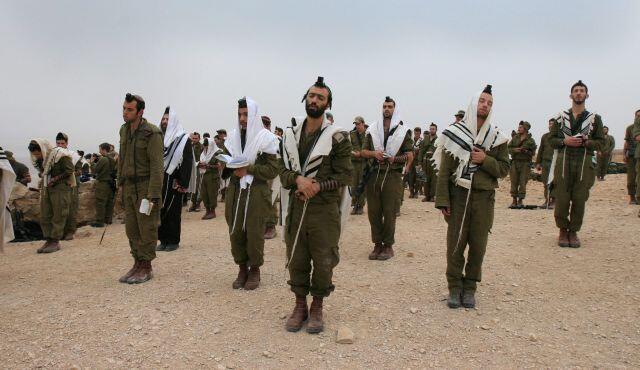
Civil trial attorney Baruch C. Cohen meets religious IDF soldiers at Nachal Chareidi Sefer Torah dedication in Mitzpeh Yericho


Rabbi Berel Wein

Staring down the barrel of a rifle
Sunday, July 21, 2013
By day a rabbi, by night a Border Police guard Meir Ohana is the chief rabbi of Kfar Yuval but that doesn't stop him from touring the north as head of a "Matmidim" Border Police unit • Ohana vocally supports haredi integration in the IDF: "Studying Torah does not preclude bearing the burden."
bbi Meir Ohana
|
Photo credit: Eyal Margolin |
When Rabbi Meir Ohana takes off his traditional black suit, he puts on a Border Police uniform. While much of the ultra-Orthodox world in Israel is up in arms over the so-called "sharing of the burden" -- the state's intent to compel Israeli ultra-Orthodox citizens to enlist in the military after years of enjoying blanket exemptions from service -- Ohana is a rare sight among his ilk.
Ohana and his wife Batya are the parents of six children, between the ages of six and 17. The rabbi was raised and educated in religious schools, but this did not dissuade him from joining the Israel Defense Forces Golani Brigade, in the tradition of his father and older brothers, who also served in the brown-bereted brigade. Ohana served in a Golani commando unit, and was transferred to the 13th Battalion, where he manned the unit's heavy machine gun.
Ohana was discharged from the army in 1986 and joined the Border Police officers corps. In 1998, he was ordained by the Chief Rabbinate and has since served as the chief rabbi in Kfar Yuval and other communities along the explosive border with Lebanon in Israel's north. He also heads the Kfar Yuval emergency squad, as well as volunteering as the Galilee firefighting department's rabbi. In 2005, he was trained to lead the "Matmidim" (counterparts to the police's civil guard), and now tours with the unit every month as part of his Border Police position.
Ohana is not only in favor of "sharing the burden" but also demands that his sons work toward the goal of greater haredi integration into Israel's armed forces as well. His eldest son is set to enlist next year, and has already undergone the trial period the IDF uses to evaluate potential elite-unit soldiers. Ohana's son will likely serve in a combat unit.
"Studying Torah and preserving the religious lifestyle don't prevent one from contributing to bearing the burden in an equitable way for all parts of society. Sharing the burden and defending ourselves against our enemies is a commandment written in the Torah," Ohana said.
Monday, June 3, 2013
Tuesday, May 28, 2013
Sunday, March 3, 2013
Shavua Tov from the IDF Rabbinate

The attached photos are from Purim morning down south at a base near Be’er Sheva from where several thousand soldiers get bussed every Sunday morning to their bases in the deep south where there is no normal transportation lines. Since this year Sunday was also Purim morning, the IDF Rabbinate, Southern command, set up a tent with Megilla readers (Megilla was read 4 times) for interested soldiers who had not heard it in shul before leaving home. (The IDF High Command issued orders that anyone who was going to shul for davening and Megilla did not have to leave home before 10 AM. Hence, all the buses were re-scheduled to leave only beginning after 11 AM instead of 9 AM. In addition to the tent and Megilla reading, I was down there with a gentleman from Brooklyn by the name of Rubin Margulis who donated 2,500 bags of Mishloach Manot and we had the z’chut to hand out all 2,500 to soldiers assembled by units before leaving on their respective buses. The first photo shows a group of Golani soldiers who after receiving the unexpected Mishloach Manot began to sing Purim songs and dance.
While this was going on, a Sgt. Major who works Mitzvot with me took care of distributing Matanat L’evyonim to many dozens of needy soldiers and their families. So while I davened at a netz minyan in order to hear Megilla and leave early enough to drive down south, and did not start my personal Purim drinking until I sat down to the Seuda at home at 4 PM upon my return, I can say that I sat down to my Seuda with the satisfaction of making sure many Jewish families of soldiers would have a Chag and spreading simchat Purim to thousands of soldiers who otherwise were destined to a very dry Purim otherwise as they went off to their respective bases to protect the rest of us at home. Enjoy the photos.
Please find below the Purim sheet of the IDF Rabbinate’s “Jewish Awareness” dept. which was distributed to many tens of thousands to soldiers throughout the army. Link below:

Thursday, January 3, 2013

Tuesday, December 11, 2012
Happy Chanukah from Friends of the IDF


Some of these heroes have taken time from their intensive schedules to seek us out and express their appreciation for everything you do. On behalf of the soldiers enjoying your contributions - THANK YOU!

Friday, October 19, 2012
Music Unites IDF Chief Chazzan & Moditzer Rebbe Shlita

IDF officials of late have been working to establish a dialogue with leaders in the chareidi community in the hope of reaching an understanding regarding the drafting of chareidim into the military.
Interestingly, the connection with the Moditzer Rebbe Shlita was made by IDF Chief Chazzan Lt.-Colonel Shai Abramson, who met with the rebbe earlier in the week and presented him with a CD of his new album, which contains a niggun that originates in the chassidus.
According to the Srugim report, Abramson arrived at the rebbe’s Bnei Brak home and was greeted warmly. The rebbe expressed great interest in the details of the IDF draft and the chazzan’s work.
Rav Klein told the rebbe he is responsible for the chareidim in the air force’s Shachar program, responding to questions pertaining to that special project.
The rebbe mentioned a letter that he recalls seeing once upon a time in which David Ben-Gurion was questioned regarding kashrus in the military. Rav Klein explained that today, a chareidi soldier receives the food he is accustomed to eating.
The rebbe asked why chareidim are needed in the IDF, to which Rav Klein stated officers are seeking additional chareidim in their units, referring to them as soldiers who make a significant contribution to the IDF. “On erev Rosh Hashanah I visited an air force base. The commander asked me to arrange that the chareidi soldiers do their reserves duty on the base as opposed to placing them in different positions in the IDF Chief Rabbinate”.
Tuesday, October 9, 2012
Wednesday, August 29, 2012
Wednesday, August 15, 2012
Draft of Ultra-Orthodox into IDF Off to a Smooth Start

More than one week after the law’s implementation, the Israel Defense Forces has yet to encounter any significant problems in putting haredi men through the draft process, according to a military source with knowledge of the issue.
The IDF had no official comment on the new process.
In previous weeks, thousands of haredim had gathered in the streets, holding protest signs declaring that they would rather spend their lives in prison than serve in the “Zionist army.” Another protest in Tel Aviv declared that secular Israelis, who had always served, would no longer be “suckers.”
But political stalemate won out. No law was passed and a broad government coalition created to solve this issue broke up.
The day before the Aug. 1 deadline, Defense Minister Ehud Barak sent out a news release stating that the IDF had one month to formulate guidelines on haredi military service that would accord with the Military Service Law of 1986, which subjects haredim to the same service requirements as all other Jewish Israelis. Haredim have been subject to the law since Aug. 1, and will be until the Knesset passes a new law on haredi service.
Under the 1986 law, 18-year-old haredi boys — until now exempt from the military draft while studying in a yeshiva — are eligible for the draft; their summons may come even before their 18th birthday. The penalty for refusing the summons: three years in prison.
The law includes a clause on religious exemptions from military service for women who observe Shabbat and keep kosher, but they do not apply to men. Men up to the age of 26 may be drafted, haredi or not.
Now haredi men born in 1994 and 1995 are or soon will be undergoing competency tests in math, Hebrew and general knowledge, as would any draftee. The first language of many haredim is Yiddish, not Hebrew, and their schools do not focus on math or general studies.
The military source could not give any details on the formulation of guidelines for haredi enlistment, but said the monthlong period was granted in part to allow the army time to prepare for absorbing thousands of haredi soldiers.
According to Haaretz, there are 54,000 haredi men of enlistment age who have not served in the IDF.
But even as the protests have died down, observers on both sides of the issue do not expect the controversy to be solved or a new law to be passed anytime soon.
“Right now there’s not a general feeling that something major is going to happen because of the political consternation,” said Rabbi Jonathan Rosenblum, a columnist for Mishpacha magazine, a major haredi publication.
Rosenblum, of Jerusalem, said that when the coalition broke up, “the sense of panic diminished considerably” in the haredi world.
Although the Military Service Law is in effect, Rosenblum was not worried that any of his seven sons, including a 17-year-old, would be putting on a uniform. Would the IDF be “subjecting them to military trial and imprisonment? No, I don’t think so,” he said. “I don’t think the government has a plan. There was nobody who was talking about putting people in jail.”
During government negotiations on a new law on the matter last month, the major proposals suggested fines for draft dodging, while others eschewed the idea of personal penalties.
A leading official in Hiddush, an Israeli organization that advocates for religious pluralism and equality, also does not expect new legislation — and a haredi draft with teeth — to move forward soon, despite his best hopes.
“The government won’t draft one yeshiva student,” said Shahar Ilan, Hiddush’s vice president. “The government isn’t doing anything. “This is a huge violation of the law.”
Ilan said that though most of the Knesset wants to see a new law enacted, no one is willing to take the necessary political risks.
“Netanyahu does not want to hurt the haredi parties” in his coalition, Ilan said. “There’s a majority for a mandatory draft but it’s theoretical because the parties that support a mandatory draft are not ready to break up the government for it.”
Rosenblum said that even were such a law to pass, the IDF would not have the resources or will to absorb so many haredi youth, whose strict observance of Jewish law puts them in special circumstances.
“There’s no way in the world that the vast majority of haredi boys are going to go into mixed units,” he said. “There’s no way in the world that the army is going to put in place haredi-accommodating units within 30 days.”
Wednesday, August 1, 2012
IDF Bans Chabad Messianist Yarmulkes The Israel Defense Forces has reiterated its ban on kippot that have writing on them, specifically noting that Chabad followers who have insisted on wearing so-called “Yechi” yarmulkes in the military may not do so.

The Israel Defense Forces has reiterated its ban on kippot that have writing on them, specifically noting that Chabad followers who have insisted on wearing so-called “Yechi” yarmulkes in the military may not do so, Yeshiva World reports, citing a report on the Ladaat news website.
The Chabad yarmules have the slogan “yechi adonaynu moreynu v’rabbaynu melech hamoshiach l’olam va’ed,” “long live our master our teacher our rabbi king messiah forever and ever” embroidered or printed on them.
The IDF generally allows yarmulkes of any size, color or material to be worn [except in some specific combat situations], but bans any writing on them.
The Chabad yarmules have the slogan “yechi adonaynu moreynu v’rabbaynu melech hamoshiach l’olam va’ed,” “long live our master our teacher our rabbi king messiah forever and ever” embroidered or printed on them.
The IDF generally allows yarmulkes of any size, color or material to be worn [except in some specific combat situations], but bans any writing on them.
Because of the number of ba'al teshuvas, people born to secular or non-Orthodox families who have become Orthodox through Chabad's missionary activity, there are many more Chabad followers in the IDF than is normal for haredi groups.
Monday, July 30, 2012
In a Jerusalem park, a group of potential ultra-Orthodox IDF recruits find a bridge between two worlds‘When someone helps me keep going during a run, I have more reason to listen to his opinions, even if he’s six years younger and has learned less Talmud than me’
Evening was falling as I walked through Jerusalem’s Sacher Park, searching for a group of haredi guys doing sprints. I figured they wouldn’t be too hard to pick out of the summer crowd, dressed as they would be in black hats with sidelocks hanging, running a 1k around the park circuit. Sacher Park is full of haredim, but not too many jogging in a black bekishe, or suit jacket.
I was wrong. I didn’t find them. It was Sefi, short for Yosefi Zeev — one of two counselors for this particular group of young haredim taking part in the Aharai pre-army training program — who eventually found me. He brought me over to sit in on their session — to join a motley but motivated group of haredi guys my age (21), who are considering induction into the IDF.
Zeev was sporting a typical workout look — shorts and t-shirt, with a small kippah perched on his shaven head. His co-counselor, Gad Shuali, wasn’t wearing a kippah, but is religious as well, as all counselors must be to participate in this haredi pre-army program run by the Aharai non-profit leadership organization.
The participants were a mix of body types, some heavy, some skinny, but the majority were not in great physical condition. None was dressed in typical haredi grab; most were wearing what looked like hand-me-down workout clothes, with outfits ranging from pants and a polo shirt to cargo shorts and third-hand Nikes. But everyone made an effort in the actual workout, said Zeev, helping one another out in the twice-weekly round of sprints, long-distance runs, push-ups, sit-ups, squats and muscle stretches.
The goal of Aharai is to help develop leadership and social skills among youth from the country’s projects, development towns, absorption centers, boarding schools and shelters. The organization, set up 15 years ago, aims to guide them toward serving in the army, which offers them a better chance of ultimately succeeding in society.
This particular Aharai group has been running for a little more than a year, and is designated for haredi young men, teaching them physical fitness skills, and giving them a chance “to leave their box,” explained Zeev.
It’s a very useful initiative — a small bridge between the insular ultra-Orthodox community and the IDF, between a closed, separate world and the rest of Israeli society, at a time of acute friction between the two. Many Israelis are increasingly intolerant of an ultra-Orthodox community they see as sponging off the rest of society, benefiting from the security, stability and the welfare framework while giving nothing in return. Many in the ultra-Orthodox world feel their lifestyle and commitment to Torah study are central to the sustainability of Judaism, and that their traditions are under intolerant assault.
The small Aharai group in the park caters for some of the few young men in the closed world who are tentatively considering even a limited foray, via the IDF, into the open one. After each two-hour workout, the counselors hold discussions on the grass, tailored to the different backgrounds and emotions of the 15 or so participants, talking Torah, morality and, societal obligations. They also organize activities in which the participants have to deal with questions of mutual responsibility, leadership and social justice.
Some graduates of this group have enlisted in the army over the past year, others haven’t, and no one is pushing them in either direction. Zeev, in fact, doesn’t feel the IDF is fully prepared for haredi enlistment.
“The IDF needs to think more about those who want to stay a part of the haredi world (once enlisted) and not just about those who are leaving it (in order to enlist),” he commented.

‘When I grow up, I’ll be a soldier in the Army of God, not in an army of non-believers’ — a sign held up at a recent ultra-Orthodox rally against conscription (photo credit: Uri Lenz/Flash 90)
It is an astute comment, considering the current upheaval over haredi enlistment in the IDF. The organization is targeting the haredi demographic just as the political leadership grapples with a framework for haredi national service.
The Deferral of Military Service for Yeshiva Students Law, colloquially called the Tal Law, was passed in 2002 as a temporary mean to legally give army exemptions to haredi yeshiva students, who had already been getting them unofficially. But six months ago, the Tal Law was ruled unconstitutional by the High Court, and as of August 1, will be off the books. The Netanyahu coalition –facing public pressure and rallies for universal conscription, and furious opposition from haredi politicians and their constituents — has failed thus far to legislate a replacement.
Interestingly, some of the Gan Sacher Aharai recruits hadn’t heard about the pro-enlistment rallies, possibly because they don’t require any preaching — they’re already considering enlistment.
Aharai established this group because of the need it sees for encouraging potentially interested haredi kids to reach that point — to at least think about joining the IDF. Each counselor fulfills a multifaceted role — confidant, mentor, personal trainer, and, ultimately, friend. Zeev is positive that the discussions influence the workouts, and vice versa. Once participants complete the physical workout, he said, “it’s easier to try to have deep conversations.”
Aharai nationwide has been running pre-army training programs for new immigrants and underprivileged citizens since 1997. This newish haredi “pilot program,” as public relations head Uri Efroni called it, still has its core objectives being refined at every twice-weekly training session. But it has been so successful that Aharai plans to start three similar groups elsewhere next year.
Moshe Lekutiel Moyale, a 21-year-old haredi from a Moroccan family in the Jerusalem neighborhood of Ma’alot Dafna, graduated the course a few months ago and was just drafted to the all-male combat unit, Netzah Yehuda. Ultra-Orthodox soldiers have been drafted to the Netzeh Yehuda Battalion for the last decade, performing “critical operational activity in Judea and Samaria,” said an IDF spokesman.

At the swearing-in ceremony of the haredi Netzah Yehuda IDF unit (photo credit: Noam Moscowitz/Flash90)
We spoke a week before Moyale’s draft date, as he was returning from his ritual dip in a local spring, velvet kippah on his head and a towel draped around his neck. He claimed “there are a lot of haredi boys similar to me.”
Moyale said he was excited to be enlisting, for the full three years. “Aharai already gave us the ability to get through hardships, so I’m not scared,” he said.
Moyale dropped out of his yeshiva in Har Nof when he could no longer afford it and began working at a grocery store. His Aharai counselors have helped Moyale with every struggle in his life, he said — physical, psychological and financial. He values the program so much that he started his own group of three or four guys in his neighborhood to exercise and discuss life values, and hopes to get Aharai to support it.
Not everyone shares Moyale’s approach on the compatibility of the haredi world and the IDF. Shalom and Yossi — they were both anxious not to be identified further — first joined Aharai for the physical fitness option and are still participating. They gradually grew more committed to the idea of serving in the army… though not sufficiently committed to sign up.
Tuesday, July 24, 2012
'Our haredi combat battalion is excellent' Kfir Brigade Commander Col. Udi Ben-Moha praises his haredi battalion, saying it "does everything. It trains, fights, detains suspects, just like any other combat battalion" • After a difficult start, the Kfir Brigade is now meeting the standards set by the IDF's other veteran infantry brigades.

"There is no problem to take a young guy from a different background and help him to achieve great things. My advice is for anyone who wants to create another haredi combat battalion to come and see how it works with us … It works well," says Kfir Brigade Commander Col. Udi Ben-Moha about the Nahal Haredi battalion in his brigade.
"The Netzah Yehuda Battalion [another name for the Nahal Haredi Battalion], proves itself. The level of combat conditioning among its soldiers is the highest in the Kfir Brigade," added Ben-Moha, who spoke with Israel Hayom to mark the August 2012 enlistment class.
According to Ben-Moha, "The Netzah Yehuda Battalion is an excellent outfit that does everything. It trains, fights, detains suspects, just like any other combat battalion. It is a good example of how haredi enlistment works."
Aside from his ultra-Orthodox troops, Ben-Moha commands six other battalions, which only in recent years have come together to form one brigade. The brigade's journey was initially difficult, but over the past few years it has gradually grown to resemble the Israel Defense Forces' four other veteran infantry brigades, the Paratroopers, Golani, Givati and Nahal.
The IDF is also considering expanding the Kfir Brigade's arena of operations in the future to include the Gaza border region. The brigade is already carrying out operational security duties along the border with Lebanon, and in its next large-scale training exercise, which will take place for the first time on the Golan Heights, the brigade will prepare itself for conventional combat along the northern border.
"We will operate as a brigade during the next conflict," said Ben-Moha. "The brigade has matured, and the decision makers in the IDF know they can trust us. The army lacks [enough] good units today, and for Kfir this is an opportunity."
Despite Ben-Moha's declarations, his brigade still has a glaring weakness compared to the veteran brigades: it doesn't have a reconnaissance battalion.
"There was a plan to create a reconnaissance battalion," Ben-Moha told Israel Hayom, "but question marks currently hang over the IDF's multi-year plans due to budgetary considerations. We very much want a reconnaissance battalion, but no unit has ever won in combat just because of its equipment. The real story is about the people, the quality of the commanders and the soldiers."
The brigade came of age in Judea and Samaria, which is the area with which it is most closely associated. On a number of occasions, the media has reported incidents of abuse and humiliation by Kfir soldiers toward the Palestinian population, but such reports have significantly dropped in recent months.
"There is no doubt that some of these incidents portrayed us in a negative light and created a bad stigma about the Brigade," admitted Ben-Moha, "but the commanders have matured, and we're now very vigilant about this issue. Our people understand this, and the issue of [our] image has become very important. These incidents are happening less and less, and even the smallest case [of abuse] is treated with utmost seriousness and with severe punishment."
This year the Kfir Brigade achieved another first. One of its soldiers, Sgt. Gal Weingarten, was awarded a citation for shooting two terrorists after they attacked and seriously wounded him. Weingarten was taking part in an operation to detain a suspect in the Hebron area, when two terrorists attacked him and managed to slit his throat with a knife. Weingarten still managed to shoot his attackers, wounding one and killing the other.
"We're proud of him," said Ben-Moha. "He's a hero – the result of the good training and atmosphere in the Kfir Brigade."
Subscribe to:
Posts (Atom)
