SOLDIERS OF IDF VS ARAB TERRORISTS

SOLDIERS OF IDF VS ARAB TERRORISTS
Showing posts with label President Donald Trump. Show all posts

Monday, May 14, 2018

From Truman to Trump A series of emails on American presidents and their relationships with Israel; Donald Trump, 2017-Present Delivering on his Israel-related pledges By Ron Kampeas, JTA DC Bureau Chief

Trump

Donald Trump, the unlikeliest of Republican presidents, has gotten a reputation for unpredictability. But if he is consistent on one thing, it is his campaign promises. He tends to keep them.
On Dec. 6, 2017, he made good on his promise to recognize Jerusalem as Israel's capital and move the U.S. Embassy to Jerusalem from Tel Aviv.
“While previous presidents have made this a major campaign promise, they failed to deliver,” Trump said. "Today, I am delivering."
Trump not only delivers, he delivers with a vengeance. Recognizing Jerusalem and setting a schedule to move the embassy would have been enough for his Jewish base, but Trump accelerated the process and the embassy will open, albeit in temporary quarters, this month.
The same goes for his other Israel-related pledges. Trump promised to block Israel-hostile actions at the United Nations; his ambassador to the body, Nikki Haley, has been perhaps the most proactively pro-Israel envoy since Daniel Patrick Moynihan under Gerald Ford. Haley has forced the United Nations to withdraw reports critical of Israel and stopped a Palestinian from assuming a senior position in the body because the same courtesy has yet to be afforded to an Israeli.
Similarly, Trump said he would reconsider the Iran nuclear deal; he pulled the U.S. from the deal in May.
"With President Trump, I have fewer disagreements," Israeli Prime Minister Netanyahu said last month when he was asked to compare his interactions with Obama and Clinton. "It’s fair to say I don’t have any disagreements."
Trump wants to revive Israeli-Palestinian talks, and has entrusted the task to a team of three, all with solid pro-Israel ties, led by his son-in-law, Jared Kushner.
In the second year of his presidency, Trump is bolder and more confident in his role, and is distancing himself from the foreign policy mavens who insist the United States must ensure stability worldwide. For example, he plans to pull out from Syria the 2,000 or so troops there training and advising U.S.-friendly rebel forces.
“It is very costly for our country, and it helps other countries more than it helps us,” Trump said earlier in April of the U.S. presence in Syria. “I want to get out, I want to bring our troops back home.”
That's not a prospect Israel relishes. Russia has joined with Iran and Hezbollah — both deadly enemies to Israel — in propping up the Assad regime in Syria. Israel is adamantly opposed to a long-term Iranian presence in Syria, and to an emboldened Hezbollah, the Lebanese militia that launched a war against Israel in 2006.
Now that Syria's civil war is winding down, the absence of a U.S. presence would give Russia, Iran and Hezbollah more room to consolidate their presence there. Already the prospect of an Israeli conflict with not just Iran but possibly with Russia islooming in Syria.
Trump's base on the isolationist right has made it eminently clear it wants out of Syria, and Trump is being responsive. The same loyalty to his base could explain the horror he has stirred among American Jews with his failure to condemn — and at times his seeming encouragement — of white supremacists.
The most searing moment was last August, when it took Trump days to unequivocally condemn the neo-Nazis who marched in Charlottesville, Virginia, an event that culminated in a car-ramming attack on counterprotesters that killed one. Trump said there were "very fine" people on both sides, drawing rebukes from across the Jewish spectrum — including, unprecedentedly, fromAIPAC and even the Republican Jewish Coalition.

Tuesday, May 8, 2018

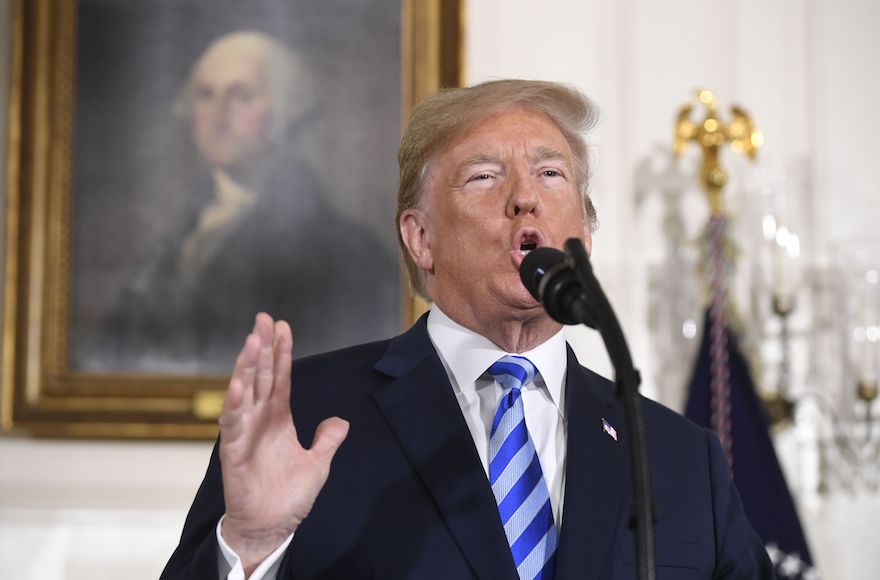
Trump withdraws US from the Iran nuclear deal

WASHINGTON (JTA) — President Donald Trump said he would not waive sanctions on Iran by a deadline Saturday, effectively pulling out of the Iran deal.
“I am announcing today that the United States will withdraw from the Iran nuclear deal,” Trump said, speaking at the White House Tuesday. “In a few moments, I will sign a presidential memorandum to reinstate nuclear sanctions on the Iranian regime.”
The sanctions Trump will reinstate target countries, businesses and individuals that deal with Iran’s financial system.
Trump’s decision comes after a full court press by three European nations also party to the 2015 deal not to pull out. Over recent weeks, French President Emmanuel Macron, German Chancellor Angela Merkel and British Foreign Secretary Boris Johnson have visited Washington to try and persuade Trump to stay in the deal. Trump and Macron, who are close, spoke earlier Tuesday.
The deal swaps sanctions relief for Iran’s rollback of its nuclear program. Trump had said he might stay in the deal if it could be renegotiated to remove “sunset” clauses that allow Iran to resume some enrichment of fissile material within a decade. He also wants a tougher inspections regime and to roll a missile testing ban into the deal.
European allies said reopening the deal now, particularly in relation to the sunset clauses, was impossible, especially given the adamant opposition of the other parties: Iran, Russia and China.
Instead, they countenanced increasing pressure on Iran in other arenas, including new sanctions targeting its missile testing, and then committing to pressure on Iran as the sunset clauses loomed closer to extend bans on enrichment.
Trump rejected those overtures. “This was a one-sided deal that should have never ever been made,” he said.
Israel and Saudi Arabia, by contrast, have been U.S. allies pressing for a pullout from the deal. Netanyahu last week unveiled documents showing that Iran had before the 2015 deal hidden the breadth of its nuclear weapons development. Trump credited Netanyahu’s presentation in making his decision. “Today we have definitive proof that this promise was a lie,” he said, referring to Iran’s pledge to roll back its nuclear program.
“It is clear to me that we cannot prevent an Iranian nuclear bomb under the decaying and rotten structure of the current agreement,” he said. “The Iran deal is defective at its core.”
It’s not clear what happens going forward. The Trump administration would have to put in place staff and mechanisms to monitor compliance with U.S. sanctions, a process that could take months, giving some leeway to renegotiate a deal. On the other hand, simply announcing the reimposition of sanctions is likely to have an inhibitive effect on doing business with Iran, effectively crippling the deal almost immediately.

Tuesday, May 23, 2017

President Trump Gives Remarks at the Israel Museum


President Donald Trump spoke at a joint press conference with Prime Minister Binyamin Netanyahu at the Israel Museum in Jerusalem Tuesday afternoon, shortly after having spoken at the Yad Vashem Holocaust museum.
In his address at the Israel Museum, President Trump described his visit to the Israeli capital as “a privilege”, referencing Jerusalem’s Jewish history going back to the reign of King David.
"It is a privilege to stand in this national museum in the ancient city of Jerusalem, to address the Israeli people and all people in the Middle East who yearn for security, prosperity, and peace.
"Jerusalem is a sacred city. Its beauty, splendor, and heritage are like no other place on earth. What a heritage, what a heritage. The ties of the Jewish people to this holy land are ancient and eternal. They date back thousands of years, including the reign of King David, whose star now flies proudly on Israel's white and blue flag."
The President also described his visit on Monday to the Western Wall – the first such visit by a sitting US President – saying he was “humbled” to pray there.
"Yesterday I visited the Western Wall and marveled at the monument to God's presence and man's perseverance. I was humbled to place my hand on the wall and to pray in that holy space for wisdom from God."
"I also prayed at the Church of the Holy Sepulchre, the site revered by Christians around the world. I laid a wreath at Yad Vashem, honoring, remembering, and mourning the Six Million Jews who were murdered in the Holocaust. I pledged right then and there what I pledge again today, the words 'Never Again'."
"Israel is a testament to the unbreakable spirit of the Jewish people. From all parts of this country, one message resounds. And that is the message of hope. Down through the ages, the Jewish people have suffered persecution, oppression, and even those who have sought their destruction. But through it all they have endured, and in fact, they have survived."
"I stand in awe of the accomplishments of the Jewish people, and I make this promise to you: my administration will always stand with Israel."
Turning to foreign policy, President Trump pledged that his administration would prevent the Iranian regime from developing nuclear weapons.
"The United States is firmly committed to keep Iran from developing a nuclear weapon and halting their support of terrorists and militias. We are telling you right now that Iran will not have nuclear weapons."

Wednesday, April 26, 2017

Full text and video of President Trump's speech at US Holocaust Memorial Museum


Thank you very much. Thank you. Friends, members of Congress, ambassadors, veterans, and, most especially, to the survivors here with us today, it’s an honor to join you on this very, very solemn occasion. I am deeply moved to stand before those who survived history’s darkest hour. Your cherished presence transforms this place into a sacred gathering.

Thank you, Tom Bernstein, Alan Holt, Sara Bloomfield, and everyone at the Holocaust Memorial Council and Museum for your vital work and tireless contributions.

We are privileged to be joined by Israel’s Ambassador to the United States, friend of mine — he’s done a great job and said some wonderful words — Ron Dermer. The State of Israel is an eternal monument to the undying strength of the Jewish people. The fervent dream that burned in the hearts of the oppressed is now filled with the breath of life, and the Star of David waves atop a great nation arisen from the desert.

To those in the audience who have served America in uniform, our country eternally thanks you. We are proud and grateful to be joined today by veterans of the Second World War who liberated survivors from the camps. Your sacrifice helped save freedom for the world — for the entire world.

Sadly, this year marks the first Day of Remembrance since the passing of Elie Wiesel, a great person, a great man. His absence leaves an empty space in our hearts, but his spirit fills this room. It is the kind of gentle spirit of an angel who lived through hell, and whose courage still lights the path from darkness. Though Elie’s story is well known by so many people, it’s always worth repeating. He suffered the unthinkable horrors of the Holocaust. His mother and sister perished in Auschwitz. He watched his father slowly dying before his own young eyes in Buchenwald. He lived through an endless nightmare of murder and death, and he inscribed on our collective conscience the duty we have to remember that long, dark night so as never to again repeat it.

The survivors in this hall, through their testimony, fulfill the righteous duty to never forget, and engrave into the world’s memory the Nazi genocide of the Jewish people. You witnessed evil, and what you saw is beyond description, beyond any description. Many of you lost your entire family, everything and everyone you loved, gone. You saw mothers and children led to mass slaughter. You saw the starvation and the torture. You saw the organized attempt at the extermination of an entire people — and great people, I must add. You survived the ghettos, the concentration camps and the death camps. And you persevered to tell your stories. You tell of these living nightmares because, despite your great pain, you believe in Elie’s famous plea, that “For the dead and the living, we must bear witness.”

That is why we are here today — to remember and to bear witness. To make sure that humanity never, ever forgets.

The Nazis massacred six million Jews. Two out of every three Jews in Europe were murdered in the genocide. Millions more innocent people were imprisoned and executed by the Nazis without mercy, without even a sign of mercy.

Yet, even today, there are those who want to forget the past. Worse still, there are even those filled with such hate, total hate, that they want to erase the Holocaust from history. Those who deny the Holocaust are an accomplice to this horrible evil. And we’ll never be silent — we just won’t — we will never, ever be silent in the face of evil again.

‘Denying the Holocaust is only one of many forms of dangerous anti-Semitism that continues all around the world’


Denying the Holocaust is only one of many forms of dangerous anti-Semitism that continues all around the world. We’ve seen anti-Semitism on university campuses, in the public square, and in threats against Jewish citizens. Even worse, it’s been on display in the most sinister manner when terrorists attack Jewish communities, or when aggressors threaten Israel with total and complete destruction.

This is my pledge to you: We will confront anti-Semitism. We will stamp out prejudice. We will condemn hatred. We will bear witness. And we will act. As President of the United States, I will always stand with the Jewish people — and I will always stand with our great friend and partner, the State of Israel.

So today, we remember the 6 million Jewish men, women and children whose lives and dreams were stolen from this Earth.

We remember the millions of other innocent victims the Nazis so brutally targeted and so brutally killed. We remember the survivors who bore more than we can imagine. We remember the hatred and evil that sought to extinguish human life, dignity, and freedom.

But we also remember the light that shone through the darkness. We remember sisters and brothers who gave everything to those they loved — survivors like Steven Springfield, who, in the long death march, carried his brother on his back. As he said, “I just couldn’t give in.”

We remember the brave souls who banded together to save the lives of their neighbors — even at the risk of their own life. And we remember those first hopeful moments of liberation, when at long last the American soldiers arrived in camps and cities throughout occupied Europe, waving the same beautiful flags before us today, speaking those three glorious words: “You are free.”

It is this love of freedom, this embrace of human dignity, this call to courage in the face of evil that the survivors here today have helped to write onto our hearts. The Jewish people have endured oppression, persecution, and those who have sought and planned their destruction. Yet, through the suffering, they have persevered. They have thrived. And they have enlightened the world. We stand in awe of the unbreakable spirit of the Jewish people.

I want to close with a story enshrined in the Museum that captures the moment of liberation in the final days of the war.


It is the story of Gerda Klein, a young Jewish woman from Poland. Some of you know her. Gerda’s family was murdered by the Nazis. She spent three years imprisoned in labor camps, and the last four months of the war on a terrible death march. She assumed it was over. At the end, on the eve of her 21st birthday, her hair had lost all of its color, and she weighed a mere 68 pounds. Yet she had the will to live another day. It was tough.

Gerda later recalled the moment she realized that her long-awaited deliverance had arrived. She saw a car coming towards her. Many cars had driven up before, but this one was different. On its hood, in place of that wretched swastika, was a bright, beautiful, gleaming white star. Two American soldiers got out. One walked up to her. The first thing Gerda said was what she had been trained to say: “We are Jewish, you know.” “We are Jewish.” And then he said, “So am I.” It was a beautiful moment after so much darkness, after so much evil.

As Gerda took this solider to see the other prisoners, the American did something she had long forgotten to even expect — he opened the door for her. In Gerda’s words, “that was the moment of restoration of humanity, of humanness, of dignity, and of freedom.”

But the story does not end there. Because, as some of you know, that young American soldier who liberated her and who showed her such decency would soon become her husband. A year later, they were married. In her words, “He opened not only the door for me, but the door to my life and to my future.”

Gerda has since spent her life telling the world of what she witnessed. She, like those survivors who are among us today, has dedicated her life to shining a light of hope through the dark of night.

Your courage strengthens us. Your voices inspire us. And your stories remind us that we must never, ever shrink away from telling the truth about evil in our time. Evil is always seeking to wage war against the innocent and to destroy all that is good and beautiful about our common humanity. But evil can only thrive in darkness. And what you have brought us today is so much more powerful than evil. You have brought us hope — hope that love will conquer hatred, that right will defeat wrong, and that peace will rise from the ashes of war.

Each survivor here today is a beacon of light, and it only takes one light to illuminate even the darkest space. Just like it takes only one truth to crush a thousand lies and one hero to change the course of history. We know that in the end, good will triumph over evil, and that as long as we refuse to close our eyes or to silence our voices, we know that justice will ultimately prevail.

So today we mourn. We remember. We pray. And we pledge: Never again.


Thank you. God bless you, and God bless America. Thank you very much. Thank you.