
Showing posts with label Rabbi Yisrael Meir Lau. Show all posts
Showing posts with label Rabbi Yisrael Meir Lau. Show all posts
Monday, April 8, 2013
Rabbi Yisrael Meir Lau on the first time he read Anne Frank's diary
Tonight is Holocaust Memorial day in Israel (it's postponed a day here when it would otherwise fall on a Sunday to avoid violations of the Sabbath).
Former Chief Rabbi of Israel and Holocaust survivor Yisrael Meir Lau describes how he felt when he read Anne Frank's diary for the first time after his arrival in Israel.


Sunday, March 24, 2013
Monday, October 29, 2012
Happy Birthday Chief Rabbi; A Los Angeles philanthropist surprised Chief Rabbi Israel Meir Lau with a birthday celebration and a gift: A miniature Torah.

The former Chief Rabbi of Israel and current Chief Rabbi of Tel Aviv was brought to the luxurious Keter Harimon hall in Bnei Brak, where many familiar faces were waiting for him.
The party was organized and sponsored by Rabbi Zvi Reisman, a philanthropist from Los Angeles and close acquaintance of Rabbi Lau.
Rabbi Lau was one of the youngest survivors of the Buchenwald Nazi Concentration Camp, where both of his parents and other family members were murdered. He is Chairman of Yad Vashem Holocaust memorial in Jerusalem.
As a gift Reisman gave him a miniature Torah with a special aron kodesh for hold it.
Wednesday, August 8, 2012
Sitting down with Rabbi Lau

Rabbi Israel Meir Lau, former chief Ashkenazi rabbi of Israel, right, is interviewed at the Chabad Lubavitch’s National Jewish Retreat in Weston by Rabbi David Eliezrie, a member of the retreat’s organizing committee.
Rabbi Israel Meir Lau, former chief Ashkenazi rabbi of Israel, sat down with a Jewish Journal reporter for a post-Shabbat interview last week at the Chabad Lubavitch's National Jewish Retreat.
The six-day program at the Hyatt Bonaventure in Weston featured Jewish scholars and authors and was attended by more than 900 Jews from around the United States.
Lau and his two brothers were the only members of his family to survive the Holocaust. He was eight years old when he arrived inPalestine in 1945.
He attended a yeshiva and became an ordained rabbi. Lau was the chief rabbi of Netanya and then Israel's chief rabbi, a position he held from 1993 to 2003. He currently is chief rabbi of Tel Aviv.
Lau's new book, "Out of the Depths," recounts his experiences in the Holocaust, including his internment in Buchenwald, and his arrival in Palestine.
He tells how he became chief rabbi of Israel and discusses his meetings with world leaders including Pope John Paul II, U.S. presidents Ronald Reagan and Bill Clinton, Fidel Castro, Nelson Mandela and Israeli Prime Minister Yitzhak Rabin.
Jewish Journal: You met with Pope John Paul II more than once. What sort of relationship did you have with him?
Lau: He was a pope who understood very well the situation of the Jewish people because he faced the Holocaust with his very eyes. He understood the tragedy.
He was the pope who brought a diplomatic relationship between the Vatican and the state of Israel. It happened in 1994.
I met the pope of today also, in Yad Vashem, Benedict XVI. But there is quite a great difference between them. The pope of today was a child in Hitler youth. As a young man, he was in the Wehrmacht, in the Nazi army. I don't blame him for that. He was born in Germany. In those years, everyone should join those movements but he was brought up on the other side of the barricade.
JJ: The other day [in an interview with Rabbi David Eliezrie, a member of the retreat's organizing committee,] you touched on compulsory military service for the haredim. How do you feel about that?
Lau: [The Tal Commission] made some conclusions how to behave, what to do. They know the needs of the army, everything. The government and the Knesset should adopt them. If there are some details you have to correct, okay.
One thing I can assure you, that enforcing service is not a way which is acceptable. It will not work. If it is in a dialogue with all the leaders involved, they understand very well the needs of the Israeli society, the needs of the state. And they want their students to be a positive and constructive part of Israeli society.
The centers of Torah learning mainly in Europe collapsed during World War II. We have to take care that this candle will not be extinguished.
JJ: There have been numerous conflicts between the haredi community and secular Jews in Israel. What do you think can be done to improve the relationship between the two?
Lau: It starts in the education, not in politics. The politicians, they come at the end of the story. But the issue starts from the very early childhood, to know one about the other, to speak one to the other. We have a lot of experiences how it can be done and it is being done.
[In] the most difficult and heroic units of the army, the majority of the officers are religious. They have a motive to defend the homeland taken from the bible and a devotion to the people of Israel. All these Jews have to be responsible, one for the other.
There are some places and fields that there is integration. They combine together Jews of all kinds, especially in times of strain with our neighbors. All of a sudden you forget all the differences, all the debates. You don't see the split, only the consensus. They have to teach themselves, if we can die together, why can't we live together?
JJ: Does this apply to recognizing other movements in Israel, like the Reform movement?
Lau: Look, there is no real Reform movement in Israel. It's more in the media than in reality. There is one Reform temple [in Tel Aviv]. In the same time, the number of the Orthodox shuls is 545.
What is the issue? Did we break a glass of the window in a Reform temple? Is there a fight? We want unity.
JJ: And how about the status of women in Israel?
Lau: There's no problem with women in Israel. In America there was never a lady president, not even a deputy president. We had already a prime minister and a president of the Supreme Court, ladies. And a speaker of the Knesset, a lady. Candidate for another presidency, a lady. Foreign office ministers, two ladies, Golda Meir andTzipi Livni. We have a problem? Seven members of the cabinet are ladies. Don't worry.
Friday, May 18, 2012


Friday, April 20, 2012
YNET: Thousands take part in March of the Living For 21st time, teens, WWII veterans, Jews, non-Jews all march together in commemoration of death marches between Auschwitz and Birkenau concentration camps
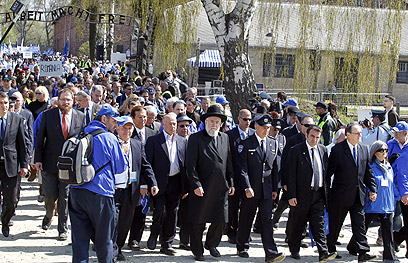
Thousands of marchers on Thursday reconstructed the journey taken by the prisoners of the Auschwitz extermination camp to the adjacent Birkenau camp in Poland.
Dozens of delegations from around the world, comprised of Jews and non-Jews took part in the march which is being held for the 21st time in memory of the victims of the Holocaust.
Rabbi Yisrael Meir Lau who took part in the march said: "We are talking about six million, 1.5 million children. These numbers are so large that we can barely imagine it.
"How can we identify with murder on such a large scale, astronomical numbers? We need to talk about the community and the families. We need to talk about the essence of one man as if he were many."
Among the delegations was one from Israel's Justice Ministry, which was joined by delegations from Australia, the US and Europe. This year, some 2,000 Polish teens also joined the march; they were accompanied by World War II veterans from the US and Canada who took part in the liberation of the concentration camps.
Speaking at the event Police Commissioner Yohanan Danino noted: "67 years ago my commander the late David Kraus who lost many member's of his family, walked out of this camp, Auschwitz. He survived the Nazi killing machine and made aliyah, 40 years later he became the police commissioner of Israel's police department."
The siren kicked off memorial services nationwide, including a wreath-laying ceremony at Jerusalem's Benjamin Netanyahu, President Benny Gantz were among the officials to lay wreaths in memory of the Nazis' victims.
The Holocaust Remembrance Day events will draw to a close at 8 pm with a service at Kibbutz Yad Mordechai. Chief of Staff Benny Gantz will be present at the closing ceremonies there and at The Ghetto Fighters' House which will mark 70 years since the destruction of the Warsaw Ghetto.
Subscribe to:
Posts (Atom)
