

Showing posts with label Nat Lewin. Show all posts
Showing posts with label Nat Lewin. Show all posts
Wednesday, November 5, 2014
Sunday, August 11, 2013
Nat Lewin Files Brief Supporting Christian Legislative Prayer
On Friday, August 2, Nathan Lewin, well-known Supreme Court advocate for Jewish religious rights, filed an amicus curiae (“friend of the court”) brief on his own behalf supporting the position of a town in New York State that has been opening Town Board meetings with prayers by Christian clergymen. A lower court held that the town’s practice was unconstitutional because “the prayer practice impermissibly affiliated the town with a single creed, Christianity.” The town’s request for Supreme Court review of the decision was supported by 49 Congressmen who said that the ruling endangered the Congressional practice of inviting clergymen of various faiths to give opening prayers and by 18 States that also expressed concern that their practice of legislative prayer was endangered. The Supreme Court agreed in June that it would review the case.
Lewin’s brief was not submitted on behalf of any organization but by him personally as an authority on church-state law who has argued important religious liberty cases in the Supreme Court and teaches a seminar at Columbia Law School on the subject of “Religious Minorities in Supreme Court Litigation.” Lewin also represented Chabad of Pittsburgh in a successful 1989 case that upheld the inclusion of a Chanukah menorah in Pittsburgh’s Holiday Display. That case figures very prominently in the current controversy before the Supreme Court. In recent years, the Supreme Court has been accepting friend-of-the-court briefs submitted on behalf of individual law professors and other individual authorities.
“Lewin said, “It is important that, in evaluating the constitutionality of ceremonial public prayer by Christians, the Supreme Court have before it the published opinions of Torah authorities and the Halachic consensus regarding Christian prayer.” Lewin’s brief cites a 1963 responsum of Rabbi Moshe Feinstein regarding Christian prayer, as well as the opinion expressed by the Lubavitcher Rebbe, Rabbi Menachem Mendel Schneerson, when the Supreme Court invalidated the New York State Regents prayer in 1962. Lewin’s brief says, “Contrary to common misconception, Jewish Law does not condemn Christian prayer.”
The friend-of-the-court brief also noted that many rabbis have been invited to give opening prayers in Congress and that their prayers have frequently been distinctly Jewish and therefore “sectarian.” The brief reproduces the prayer given in 1860 by the first rabbi invited by Congress and notes that, according to historian Jonathan Sarna, he appeared “bedecked in a white tallit and a large velvet skullcap.”
When the Supreme Court last considered the constitutionality of legislative prayer 30 years ago in a case concerning a Nebraska Christian clergyman, all Jewish amicus curiae briefs challenged the constitutionality of the Nebraska practice. The Supreme Court, however, found the Nebraska program constitutional. “The Supreme Court must be informed this time,” said Lewin, “that America’s Jewish population is not unanimous in objecting to Christian prayer or in seeking the suppression of pleas for Divine blessings at governmental sessions.”
The Supreme Court will probably hear the case (Town of Greece v. Galloway, No. 12-696) in November and issue a decision before the end of June 2014.


From Sinai to the Supreme Court; Civil liberties attorney Mr. Nathan Lewin revisits his past victories to examine their impact on the Jewish community and the state of religious freedom in America today.

From the National Jewish Retreat taking place now in Alexandria, VA: From yarmulkas in the military to public menorah displays, civil liberties attorney Nathan Lewin has argued some of America’s most famous First Amendment cases. In this session he revisits his past victories to examine their impact on the Jewish community and the state of religious freedom in America today.
Friday, May 27, 2011
Appellate Lawyer of the Week: Nathan Lewin by Tony Mauro The National Law Journal
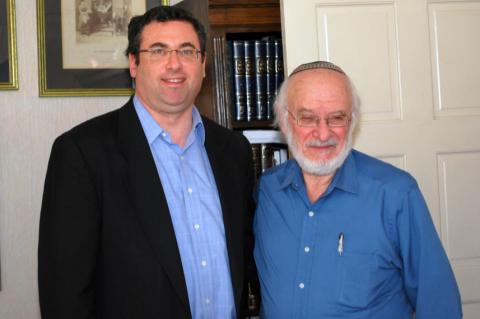
Civil trial attorney Baruch C. Cohen with constitutional law expert Nat Lewin, Esq.
The case is Zivotofsky v. Hillary Clinton, Secretary of State, asking the Court to uphold a 2003 federal law that directs the State Department, on request, to list Israel as the place of birth on passports for U.S. citizens who were born in Jerusalem.
The issue has touched a nerve with the Obama administration, which said in its opposition to Lewin's petition, "The status of Jerusalem is one of the most sensitive and long-standing disputes in the Arab-Israeli conflict." For the last 60 years, the brief adds, presidents have avoided recognizing Jerusalem as the capital of Israel – or even as located within Israel – lest they "critically compromise" their ability to promote the peace process between Israelis, Palestinians and others. In his May 19 speech on Middle East policy, President Obama referred to the "wrenching and emotional" issue of the future status of Jerusalem.
The justices stepped into this controversy based on Lewin's 12-page petition, less than one-third the length of most Supreme Court briefs.
"I'm a great believer in writing short," shrugs Lewin, who is partner with his daughter Alyza in the D.C. firm of Lewin & Lewin. "In my seminar, I tell kids that there's nothing better than a short petition." Lewin teaches a class on Supreme Court advocacy at Columbia Law School.
Menachem Zivotofsky is "my youngest client," Lewin says. Zivotofsky was born in Jerusalem in 2002, but because both his parents were born in the United States, he is a U.S. citizen. When his mother Naomi applied for a U.S. passport for her son, she requested that his birthplace be listed as Israel. Her request was denied, even though Congress had just passed a budget bill that included a provision directing the State Department to list a Jerusalem-born citizen's birthplace as Israel if requested.
When President George W. Bush signed the bill, he issued a signing statement that said the Jerusalem provision "impermissibly interferes with the President's constitutional authority to conduct the nation's foreign affairs and to supervise the unitary executive branch."
Naomi Zivotofsy was a childhood classmate of Alyza Lewin, and agreed to make a test case out of her passport dispute. The U.S. District Court for the District of Columbia dismissed the case as a "quintessential political question" beyond the jurisdiction of the courts. The U.S. Court of Appeals for the D.C. Circuit affirmed, ruling that the statute interfered with the president's Article II constitutional duties to "receive ambassadors and other public ministers," which includes deciding which government is sovereign over a particular place.
But Lewin views the case as "just asking the Court to enforce a statute, not to decide a policy." And the statute, he asserts, is in the category of a "valid passport regulation" that courts have ruled on before. A citizen's place of birth is included in passports, he said, not to make a political statement but rather to help in identifying the passport holder. On the signing statement issue, Lewin said that if Bush opposed the Jerusalem provision of the law, "the proper step is to veto the statute."
Lewin plans to argue the case when it is heard in the fall, a decision his daughter supports. "I would rather hear my father argue" than argue herself, she said.
It will be his 28th appearance before the Supreme Court, in a long career that began in the solicitor general's office 40 years ago under Archibald Cox and Thurgood Marshall. Before that, he clerked for the second Justice John Harlan.
"When Cox argued, it was like he was giving a class," Lewin recalled. "The justices took notes and didn't ask any questions." Though Lewin has not argued before the Court in more than a decade, he knows the Court is "a very hot bench," but it does not faze him. "Part of the fun of getting up there is getting all those questions."
After his government service, Lewin helped found one of the early boutique litigation firms in D.C., Miller Cassidy Larroca and Lewin. One of its alumni, Seth Waxman, became solicitor general and now heads the Supreme Court and appellate practice at Wilmer Cutler Pickering Hale and Dorr. Asked about Lewin's eagerness to take on a Supreme Court case at age 75, Waxman said Lewin is "at once a true mensch, a brilliant and creative mind, and a genuine force of nature." Lewin left Miller Cassidy when it merged with Baker Botts 10 years ago.
Before and after the move, a significant part of Lewin's workload has been what he calls "Jewish cases," typically involving Orthodox Jews whose practices raise issues under the religion clauses of the First Amendment.
In 1986, he argued in Goldman v. Weinberger before the Supreme Court, asserting unsuccessfully that a rabbi in the Air Force should be allowed to wear a yarmulke on duty. Congress changed the law, but related issues remain. Lewin is currently representing an Orthodox rabbi who was barred by the Army from serving as a chaplain because he would not shave his beard – even though some Sikhs have been allowed to keep theirs.
Lewin also argued in the 1989 landmark Allegheny County v. ACLU, which resulted in a split vote upholding the display of a menorah on public property, but not a Christian nativity scene. Battles over crèches in town squares are still a seasonal staple.
"People keep calling me" with Jewish cases, Lewin said with mixed emotions. He's glad to be asked, but wishes more Orthodox lawyers were willing to get involved.
During a stint in the Justice Department, Lewin explained, he drafted the feature of the Civil Rights Act that forbids discrimination in the workplace on the basis of religious observance. That, he said, led to "a lot more religiously observant Jews in law firms."
But, Lewin said, "one of the disappointments I've had" is that this influx has not resulted in "a large group of Orthodox Jews ready to take up the cudgel of these cases." Asked why, Lewin shrugged and said, "It's the economics of it. They have families. The profession has turned into a business, and it's not so easy to take on these pro bono cases."
In the Zivotofsky case, for example, Lewin said, "We have not collected a penny. But somebody had to be willing to do it." Lewin said his practice "hasn't been as remunerative as a big law firm, but it's been satisfying." And he'll keep at it as long as he can. Said Lewin, "It's a mistake to retire."
Tony Mauro can be contacted at tmauro@alm.com.
Sunday, October 31, 2010
Rubashkin Judge Rules on Her Own Conflict of Interest—Draws Rebuke as “Arrogant”

U.S. District Judge Linda Reade issued a ruling on October 27, 2010 denying a motion for new trial for Rabbi Sholom Rubashkin – a former meatpacking executive who was convicted in 2009 of financial fraud following an immigration raid on his family’s Postville, Iowa company, known then as Agriprocessors. Rubashkin’s attorneys, led by Nathan Lewin of Washington, D.C., have called the judge’s conduct “arrogant.”
Reade, in essence, self-ruled on charges of her own misconduct. She found that there was not sufficient new evidence presented to the court to warrant a new trial based on her judicial misconduct. The 50-year-old rabbi is currently being held in a federal prison in Otisville, NY. Rubashkin, who belongs to the Chabad-Lubavitch movement of Judaism, was found guilty of 86 financial fraud charges in 2009. He was sentenced to 27 years in prison and was ordered to pay $27 million in restitution. Numerous legal and judicial experts, among them six former U.S. Attorneys General, have questioned the severity of the sentence.
Attorney Lewin has argued that new evidence shows that Judge Reade, who presided over the trial, actually participated in planning the 2008 raid by U.S. Immigration and Customs Enforcement agents at Agriprocessors. Some 400 undocumented foreign workers were arrested and then deported. Rubashkin’s defense argued that Reade could not be impartial in her finding against the rabbi, arguing that she should have recused herself from the case, and that the court’s involvement in the raid was illegal. Their contention was supported by affidavits from the chairman of the American Bar Association’s Committee on the Code of Judicial Conduct and by a NYU law professor who is the country’s leading expert on legal ethics. They concluded that the judge had committed judicial misconduct and the prosecutors had committed prosecutorial misconduct. Attorney Lewin vowed to appeal Reade's decision and rejected the Judge’s reasoning.
“Judge Reade took a leisurely 49 days (from September 8 to October 27),” Lewin stated, “while Sholom Rubashkin is languishing in jail, to issue a brief ‘Order’ in which she totally fails to address the serious allegations of judicial misconduct that were made against her. It was unprecedented judicial arrogance for her to rule on her own guilt – to assess herself the serious charges against her that are proved by the government’s documents. And the case she presented for herself is woefully inadequate.”
Rubashkin’s defense acquired documents through a Freedom of Information Act request, which they say showed federal agents met with Reade regarding the raid. The U.S. Attorney’s Office said there was nothing illegal about the court’s involvement in the raid planning, in light of the fact there were going to be so many arrests and prosecutions. The court needed to be aware for planning purposes. In her self-ruling, Judge Reade denied that the internal Immigration and Customs Enforcement memoranda discovered under the FOIA request constitute “newly discovered evidence,” and held that there is nothing in the documents that would be admissible on any issue relating to Rubashkin’s conviction of bank fraud and other charges. Reade said Rubashkin failed to make any arguments based on the documents that he could not have raised before trial. Rubashkin claims the FOIA documents report that Judge Reade “supported” the enforcement action, but she ruled that this misstates and mischaracterizes her role. Reade said her “support” was clearly in the context of the court’s duty to logistically prepare for the arrest of hundreds of persons.
As to the issue that Reade should have recused herself from the case, she said that a federal statute directs that a judge must be recused if her/his impartiality might reasonably be questioned. Passing judgment on her own involvement, Judge Reade said, “Based on the facts and ignoring all rumor and innuendo, the court finds that recusal was not required in this case.” Reade claims that she had to ensure court proceedings are efficient and to provide all constitutional guarantees for defendants arrested in the raid. According to the judge, if she had recused herself, it would provide incentive to defendants to “advance rumors and foster speculation in the media in an effort to judge shop. The court declines to do so.” Saying that there was no Eighth Circuit Court precedent for referring the motion to another judge or requiring discovery, as Rubashkin had requested, Judge Reade said that the motion was “totally devoid of merit.”
In a scathing rebuke, Lewin stated, “Her ‘Order’ addresses none of the specific events that prove the bias that led her to impose a 27-year jail sentence on a first-time, non-violent offender who was found guilty of overstating the security for his bank loan. She does not disclose or explain (1) how often or why she met repeatedly with the prosecutor on many occasions beginning six months before the raid; (2) whether and why she requested a meeting with “many attendees” from law enforcement, at which there were “discussions about numbers, potential trials,” and during which, she stated she was “willing to support the operation in any way possible;” (3) whether and why she attended a March 17, 2008, meeting with prosecutors at which “parties discussed an overview of charging strategies;” (4) whether and why she demanded from the prosecutor a “final game plan” on the anticipated raid in the weeks preceding it; and (5) whether and why she had weekly meetings with the prosecutor in the weeks preceding the raid. These events – proved by the government’s own internal memoranda – are probably the tip of the iceberg. We have sought discovery for additional and redacted documents related to Judge Reade’s participation in the raid, but Judge Reade summarily dismissed the notion that the public be given the chance to see the full extent of her biased actions.”
Lewin added, “Judge Reade’s failure to disclose facts regarding her own conduct repeats her failure to disclose the details of her involvement in the planning for the raid to Mr. Rubashkin’s lawyers in November 2008, when she set a deadline for the filing of a motion to recuse her from further participation in the case. She ignores in her ‘Order’ the sworn affidavits of Mr. Rubashkin’s lawyers, that had they known what has now been disclosed by the ICE documents, they would have moved to disqualify her. And under governing standards set by federal law and U.S. Supreme Court decisions, she would have been disqualified and could never have made the dozens of rulings in Mr. Rubashkin’s trial that harmed him and resulted in the jury’s adverse verdict.”
Vowing to rigorously pursue the case, Lewin stated, “We are confident that the Court of Appeals will not tolerate these violations of fair and due process, and that Mr. Rubashkin will be vindicated in the appellate process.”
Cutting Edge senior correspondent Martin Barillas is editor of Speroforum.
Subscribe to:
Posts (Atom)
