
Showing posts with label Rosh Hashana. Show all posts
Showing posts with label Rosh Hashana. Show all posts
Tuesday, September 3, 2013
Rosh Hashanah 2013 - God Forgives Those Who Forgive Others Posted by Salvador Litvak

The Days of Awe are almost upon us! Accidental Talmudist Sal Litvak sounds the shofar as the minutes tick away.
Rav Huna the son of Rav Yehoshua became ill. Rav Pappa went up to inquire about him, and saw that Rav Huna was on the brink of death. Rav Pappa told the people around him, “Supply him with provisions for his journey (i.e. dress him in burial shrouds).” In the end, however, Rav Huna recovered. Rav Pappa was embarrassed to face him. They said to Rav Huna, “What did you see?” He said, “Indeed it was as Rav Pappa said – I was about to die, but at the last moment, the Holy One, Blessed is He, said to the Heavenly Tribunal, ‘Since he does not stand on his principle, do not take a strict stand against him.’ As it is stated, He pardons transgression and overlooks sin. Whose transgression does He pardon? One who overlooks sins committed against himself.” (Rosh Hashanah 17a, Talmud Bavli, Schottenstein Edition)
This year I approach the Days of Awe with great trepidation. I am no Sage. I am neither as righteous nor as pious, not as learned nor as successful, as Rav Huna and Rav Pappa. These Sages of blessed memory were close friends, spiritual leaders, and wealthy partners in the beer business. How they balanced all those responsibilities is a mystery to me. I feel like my to-do list gets longer every day, even the high-priority items.
One such overdue item is posting a new piece here on Accidental Talmudist. I’ve been writing for the Huffington Post in relation to history and politics, often channeling my Talmud energy into Abraham Lincoln-related insights that help me reach a broader audience, and thus spread the word about my new film, Saving Lincoln. The truth is, I am terrified by the financial instability that accompanies my filmmaking career, because I have a wife and children who depend on me.
I have never been able to pursue stories about sex, violence, horror, etc. because I couldn’t bear to throw years of my heart and soul into those subjects. Please don’t get me wrong – I often enjoy movies that contain those elements, but I feel called to create something different. So I have endeavored to both entertain and inspire with films like When Do We Eat? and Saving Lincoln. I feel good about my choices, but inspiring films simply don’t pay the bills as readily as nudity and gore. Sometimes I wonder if I’ve picked the wrong principle to stand upon.
Rav Huna tells us he was rewarded with a life-saving cure because he did NOT stand on principle. Of course, he’s talking about a different kind of principle. He was rewarded for not holding grudges. The Talmud includes this story in its discussion of Rosh Hashanah because we all come before the Heavenly Tribunal during the Days of Awe between Rosh Hashanah and Yom Kippur.
The resulting decree determines who will live and who will die in the coming year, who will fall sick and who will be healed, who will gain respite from financial stress and who will not. Our Sages tell us there are some few individuals who are so righteous that they are sealed for a favorable decree on the first day, and a few more who are so wicked that they are immediately sealed for the opposite. The vast majority of us, however, occupy the middle ground. We must pass before the Heavenly Tribunal and have our deeds examined. During that ten day trial, we are permitted, and even encouraged, to throw ourselves upon the mercy of the Court.
If we cry out sincerely to God for forgiveness, and commit to making positive change, it is likely that we will be forgiven, because God pardons transgression and overlooks sin (Micah 7:18). God will not, however, forgive the wrongs we do to each other, because only the wronged can forgive (Rosh Hashanah 17b). And so, we must examine our interactions with other people carefully, rushing to make amends and seek forgiveness in the little time which remains before the Days of Awe come upon us.
My friends, please forgive me for being distant as the Accidental Talmudist while I’ve been striving to promote my film. I do not kid myself that you’ve been anxious over my absence, but I have indeed failed you, as I came to understand this past Shabbat, when I had the honor to teach a bit of Torah at the Library Minyan, here in LA. In preparing my remarks for a congregation that includes many, profoundly learned rabbis, professors and righteous individuals, I realized that I have something unique to contribute as the Accidental Talmudist, and therefore I have to do it. As Moses tell us, this thing is very near to you, in your mouths and in your hearts that you may do it(Deut. 30:14). For me, that "thing" is learning and teaching the ways of Torah from my unusual perspective as a Jewtino husband, father, son of a Holocaust survivor, filmmaker, writer, and ex-lawyer, who stumbled into, stayed with, and read the whole Talmud.
With God's help, I have managed to remain active at Facebook.com/AccidentalTalmudist, where I try to post a bit of our tribe’s ancient wisdom every day. Even if you are not on Facebook, you can visit the page and see the posts. It’s a valuable forum because it’s easy to comment, discussion flows freely, and we’ve formed a vibrant community of 8,000+ people who enjoy walking the path toward wisdom together.
Rav Huna teaches us that the Lord forgives those who forgive others. I remember a great phrase from Jonathan Franzen’s novel, The Corrections, in which a character is continually “compiling evidence” of her victimhood at the hands of loved ones. Oy! Terrible idea, and yet, we all do it. We’ve got to let go of that stuff, so we can move forward. There’s just not enough time in our days, nor in our lifetimes, for that junk.
Rav Huna’s story also reminded me that “letting go” applies to more than the grudges we nurse over deep hurts and years of aggravation. It’s also about not “standing on principle” when that principle blocks the ways of peace. In other words, being right is not so important. Recognizing that we all make clumsy mistakes, and that we do it all the time, goes much further. Once we enter that frame of mind, we’ll be much slower to create those grudges in the first place. If on the other hand, we don't pursue the forgiving frame of mind, then we won't really make any positive change at all, and we’ll find ourselves regretting a whole new crop of grudges next year.
My prayer for all of us is that we treat one another with a little more forgiveness in the coming year, emulating the humility and friendship of Rav Huna and Rav Pappa. And may we all be blessed with infinite health, sweetness, friendship and prosperity! L’shanah tovah!


Wednesday, August 28, 2013
Sunday, August 25, 2013
Wednesday, September 19, 2012
Sunday, September 16, 2012
Monday, September 3, 2012
Tuesday, October 4, 2011
Sunday, October 2, 2011
NYT: In Brooklyn, Horn Lessons by a Rabbi Ring Out; In his corner of Brooklyn, he has the status of a Louis Armstrong, though he is a young man with a different kind of horn.

Rabbi Levi Yitzchok Meisner is an expert on the shofar, the ram’s horn whose wailing, shivering sounds Jews will hear in synagogues across the world on Rosh Hashana, the two-day holiday that began at sundown Wednesday. Though he no longer blows the shofar at formal services, he has taught scores of shofar blowers who do, especially in the heavily Hasidic neighborhood of Borough Park, where he lives.
Many people think the shofar is a relatively simple wind instrument to master; after all, it does not have anything like the range of do-re-mi notes that Mr. Armstrong could evoke from a trumpet. But Rabbi Meisner, 28, a lush-bearded father of two whose main livelihood is as a kosher supervisor for a rabbinical court, will tell you its simplicity is deceptive.
It does not take many lessons to learn the shofar, he said, but it takes a good deal of practice, practice, practice to sound an elegant tekiah, shevarim, teruah — the three varieties of sounds that in various combinations are blown on Rosh Hashana and in abbreviated form at the close of Yom Kippur.
“You can’t teach how to blow,” he said, with the seeming incongruity of a Mel Brooks “2,000-Year-Old Man” routine. “It’s more to take away the bad habits that detract from blowing. Most people blow with a lot of effort, a lot of power. It’s exactly the opposite.
“There’s a fancy word with trumpets: embouchure,” he continued. “That tells you how to hold the trumpet in the lips, not to push too tight. The sounds happens by tiny vibrations. As the Talmud says, ‘Intelligence, not work.’ ”
The other day, Rabbi Meisner, wearing his daily garb of a navy frock coat over a vest and white shirt buttoned at the neck, was instructing Yeedle Melber, 33, while a recent graduate, Rabbi Yechiel Lichtenstein, looked on. Mr. Melber said he wanted to be able to blow the shofar this holiday for his mother, who cannot leave the house because of recent surgery. Eventually, he said, he would also like to blow the shofar for his shtibl — a room-size house of worship. He can do an adequate long tekiah and the trio of shevarim notes, but the nine short blasts of the teruah elude him.
“I fell into a trap that a lot of people do,” Mr. Melber said. “I get tense.”
“That’s the No. 1 killer,” Rabbi Meisner agreed.
“You have to become one with the shofar,” Mr. Melber said, echoing a mystical phrase of Rabbi Meisner’s. “You have to make peace with the shofar.”
In recent weeks, Rabbi Meisner coached more than 50 students with two or three lessons apiece; he estimates that he has taught several hundred students in recent years. The need is great because Borough Park has 200 synagogues. But his influence will also be felt farther away — in a town outside Kiev in Ukraine, for example, where Rabbi Lichtenstein will be jetting in to lead a congregation that does not have a rabbi.
Until now, Rabbi Meisner has not usually charged for lessons, but students typically will buy a shofar from him; he sells them out of his living room for $50 to $250 apiece.
Shofars are reminiscent of the ram that Abraham sacrificed in place of Isaac, a Torah tale read on Rosh Hashana’s second day. Shofars were blasted at Mount Sinai and in Joshua’s capture of Jericho. Thereafter, they were blown as a call to battle or as a summons to the ancient Temple in Jerusalem. Believers expect the Messiah’s arrival to be announced with a shofar’s sound.
Shofars are mostly produced in Israel, Morocco and China, and the horn can come from a ram or almost any other kosher animal — some Jews prefer the spiraling horn of a kudu antelope — but the animal need not be slaughtered in kosher fashion. After the horn is cut off the carcass, its core is removed and the horn is heated by blowtorch or in oil so it can be straightened out for the drilling of a hole that joins the slender tip with the naturally hollowed-out fatter end. The horn is sanitized with an antiseptic solution, sanded, polished and sometimes carved with teethlike decorations. Any puncture, even if it is repaired, renders the shofar ritually unfit. For Jews, hearing the shofar is a mitzvah — a required, virtuous deed. In the ultra-Orthodox world, women are encouraged, though not obligated, to hear the shofar; they are also permitted to do the actual trumpeting, but only at a service for other women.
Hearing the sound of the shofar is so essential that some synagogues are architecturally designed to assure that the acoustics do not resonate with strong echoes that overwhelm the shofar’s pure sound. On this point, Judaism makes an important distinction.
“If you hear the echo alone,” Rabbi Meisner said, “you don’t fulfill the mitzvah.”
Wednesday, September 28, 2011
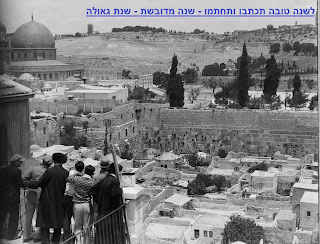
Rosh Hashanah, The Jewish New Year, Begins Wednesday Night
The Jewish People begin the High Holydays on Wednesday evening, ushering in the year 5772 by starting nearly a month of special days: Two days of Rosh Hashanah on Thursday and Friday are this year followed immediately by Shabbat Shuva, the Sabbath of Repentance, and on Sunday by the Fast of Gedaliah.
Rosh Hashana is also the start of the Ten Days of Repentance which culminate with the solemn Fast of Yom Kippur on the tenth day of Tishrei. Special verses about repentance are added to the silent Amidah prayer said three times daily during these ten days.
This is Judaism's time for introspection, when Jews look back and examine their actions in the year that has just ended, seeking to improve their observance of the Torah’s commandments directed towards G-d and towards their fellow man. They are expected to ask forgiveness from those they may have offended or hurt during the past year.
On the Sabbath of Repentance this Saturday, a special chapter is read from the book of the prophet Hosea, calling the Jewish people to repent and return to G-d. Rabbis traditionally deliver a sermon, drasha, on repentance in the afternoon.
The Fast of Gedaliah commemorates the end of Jewish rule in the Land of Israel following the destruction of the First Holy Temple some 2,500 years ago, prompting the sages to say that the end of Jewish independence is comparable in solemnity to Yom Kippur.
The Jewish New Year has several names, among them the Day of Judgment. It is a time for careful stock-taking of one's relationship with G-d, and the longer Rosh Hashanah morning prayers filled with emotion, responsive readings and songs, are therefore intense and inspirational – usually led by a carefully chosen cantor or member of the congregation - concentrating on G-d's Kingship, eternal presence and His judgment of all creatures.
“Repentance, prayer and charity avert the evil decree” is a central line from the Machzor, the special holiday prayer book, listing the course of action that it is hoped will lead to meriting a good year.
Upon returning home after the evening prayers, symbolic foods – simanim - are served, whose names allow a play on words that ask for our merits to be numerous, for our enemies to be destroyed, that we lead rather than follow. There are especially sweet ones, such as apples dipped in honey, to symbolize a sweet year.
Fruits that require a special Shehecheyanu blessing, said for something new, because they are being eaten for the first time since the previous season, are served on the second night. Pomegranates are often used for this purpose. Traditionally, children wear a new garment for the first time the second night and can say the blessing. Candles are lit both nights, but it is forbidden to light a match on the holiday, so an existing flame is used to kindle them.
Based on the commandment in Numbers 29:1, 100 shofar blasts are dramatically sounded throughout the prayers, "awakening" us to improve our ways. The congregation refrains from speech from the first shofar blasts until the last ones at the end of the service..
The Tashlikh prayer is recited on the first afternoon, preferably near a live stream of water in which we ask G-d to "throw away" our sins.
Many religious Israeli youth spend the holiday at secular kibbutzim to lead the services, volunteer to lead services in the IDF and in hospitals. Breslover Hassidim and others have begun a custom of going to Uman, Ukraine, to pray at the gravesite synagogues of their spiritual leader, Rebbe Nachman of Breslov, who passed away in Tishrei of 1810. Prominent rabbis, however, oppose the idea of leaving the Holy Land to spend Rosh Hashana in the Diaspora.
Five days after Yom Kippur the holiday of Sukkot begins, which in Israel, is seven days long, but is two days longer in the Diaspora, culminating the month of holidays.
Monday, September 26, 2011
Sunday, September 25, 2011
Thursday, September 22, 2011
Subscribe to:
Posts (Atom)
