SOLDIERS OF IDF VS ARAB TERRORISTS

SOLDIERS OF IDF VS ARAB TERRORISTS
Showing posts with label Google. Show all posts

Monday, October 21, 2013

ISRAELYCOOL: Google Search: Jews Should…

In the hours BC (before coffee), that is, while I’m bleary-eyed and imbibing my two allotted cups of the day, it is my wont to go through a minimum of 12 hours’ worth of my Facebook newsfeed, posting and commenting on items that catch my interest. This morning, a screenshot of a Google search, shared by Elad Nehorai over at PopChassid caught my eye.

(photo credit: Varda Epstein)
As you can see, the words, “Jews should,” were entered into the Google search box and Google obligingly attempted to fill in the rest of the search parameters according to the most popular searches starting with the words, “Jews should.”
We get:
jews should be wiped out
jews should leave Israel
And the ever popular:
jews should get over the holocaust
I’m the skeptical type, so before I went ahead and shared this item, I checked it out on my own. I opened a new tab in my browser, went to Google and repeated Elad’s search.
Bingo. Got exactly the same thing.
So I shared Elad’s screenshot with a comment stating that I had repeated the search with the same results. But a funny thing happened at that point. My friends started sharing their own screenshots and they were not homogeneous.
L. commented, for instance, “Mine said “Jews shouldn’t eat gebrokts” but my Google is Chabad. What can I say,” while M wrote, “Well this is what I got. Jews for J… , Jew’s Harp, Jews in Hollywood and my personal favorite – Jews in Space.”
The various responses got me thinking. It’s not a new idea that Google tailors searches to its users, Google explains it this way:
By personalizing your results based on your search history, we hope to deliver you the most useful, relevant content for your search. Search history personalization is just one of the ways that we show you more personalized search results.
So keeping this in mind, it makes logical sense that when L searches, “Jews should,” she gets something about not eating gebrokts because L is into Chassidus and her Google history would reflect that interest, while M gets funny stuff because his hobby is creating Jewish political cartoons and he appreciates quality comedy.
Then I remembered something. Just before the High Holidays, I talked to my manager atKars4Kids, Robert Moskovits, and he gave me a short lesson in using Google to take the pulse of our nonprofit organization. He gave me a search term and we each did the same search. We got different results.
Then Robert showed me how to use the Google Chrome browser to make a search unadulterated by my personal preferences by using Google’s incognito mode. Once I adjusted for region, we both got the same results using the same search parameters. I thought this was a super cool geek thing to know and I stored it away in my mind for future reference.
Google says this about the incognito browsing mode:
For times when you want to browse in stealth mode, Google Chrome offers the incognito browsing mode. Here’s how the incognito mode works:
  • Webpages that you open and files downloaded while you are incognito aren’t recorded in your browsing and download histories.
  • All new cookies are deleted after you close all incognito windows that you’ve opened.
  • Changes made to your Google Chrome bookmarks and general settings while in incognito mode are always saved.
I decided to open a Chrome incognito window and repeat the “jews should” search there, hoping for a definitive answer as to the most likely worldwide searches starting with these two words. I got this:
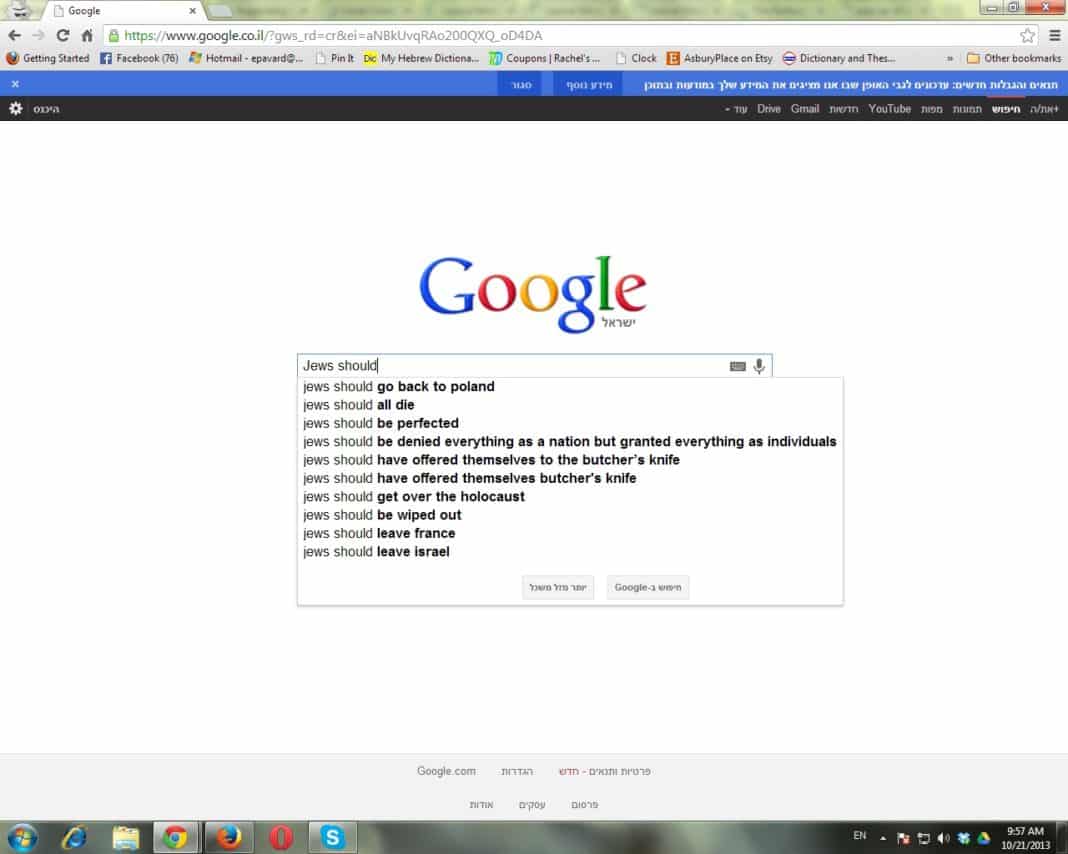
Jews should
jews should go back to poland
jews should all die
jews should be perfected
jews should be denied everything as a nation but granted everything as individuals
jews should have offered themselves to the butcher’s knife
jews should get over the holocaust
jews should be wiped out
jews should leave france
jews should leave Israel
It was incredibly painful to read these results, especially since I realized that these results are representative of world feeling against the Jews as opposed to Google just spitting out what it thinks I want to see. Just to make sure, I asked RealJStreets here at Israellycool to repeat my search using the incognito browsing mode. RealJ opened an incognito session and got an exact duplicate of my results, after adjusting for regional settings.
So there you have it in a nutshell, folks. This is the truth of what the world thinks about the Jews and about Israel: We don’t deserve our own state; we should go back to Eastern Europe and die. We should have offered our necks up to the Nazi butchers. We should stop b****ing about the Holocaust; we should be annihilated; we should leave Israel Judenfrei; and get out of France.
Oh, and that bit about being perfected? We should convert to Christianity because let’s face it, as Jews, we’re fatally flawed.

Wednesday, February 23, 2011

Some in Israel warn against Google Street View

The government decides to work with Google to bring Street View to Israel in the coming months, but some cabinet members worry that the street-level photographs will help terrorists plan attacks.

Google Street View


Israeli Cabinet members have decided to work with Google on issues related to a possible launch of Street View. Above, a Google camera on a snowmobile near the Matterhorn in Switzerland.
    In Israel, government officials are worried that the service could endanger public figures by giving terrorists detailed information that could be used in carrying out attacks.

Israel said Monday that it was weighing whether to allow Google to photograph Israeli cities to promote tourist sites despite risks to privacy and safety. Street View allows users to virtually tour locations in 27 countries. Google collects three-dimensional images for the service by dispatching a fleet of camera-equipped vehicles to the locations.
Israeli Cabinet members, led by Intelligence Minister Dan Meridor, have told experts to find a safe way to introduce the feature "as soon as possible," according to an official statement. Cabinet members discussed the security and privacy implications of Google Street View on Monday and decided to work with Google in launching the service in the coming months, according to a statement.
Google said it had no specific time frame for launching Street View in Israel. In an e-mailed statement, a spokesperson said: "We aim to offer the benefits of street-level imagery to users all around the world, however, we have nothing specific to announce at this time."
But some in Israel are sounding the alarm.
"We already have problems with Google Earth, which exposes all kinds of facilities," retired Lt. Col. Mordechai Kedar told the Associated Press. The 25-year veteran of Israeli intelligence said that Street View could facilitate terrorist attacks.
Palestinian militants in the Gaza Strip have said they use Google Earth, which displays satellite images of homes and buildings, to identify targets for rocket attacks.
The privacy watchdog group Center for Digital Democracy warned of another potential downside for Israeli citizens: It could be used for political purposes, including government surveillance.
"It will be the Israeli security forces, in addition to users, that will be viewing the system to identify potential threats and those suspected of potential anti-governmental actions," said Jeffrey Chester, executive director of the group. "The melding of governmental and commercial interests to enhance citizen eavesdropping is a chilling prospect."
Israel has long tried to strike a balance between the innovation in its booming high-tech sector and the risk of terrorism. Chester pointed to Google's acquisition of Quiksee, an Israeli company that allows users to upload videos of places to Google Maps.
Google Street View has encountered intense scrutiny from lawmakers and regulators in a number of countries and in the United States, where there are concerns that Street View invades personal privacy. Google further raised privacy anxieties last year when it admitted that its vehicles inadvertently collected unencrypted data from Wi-Fi networks, setting off an intense firestorm of criticism. Google has stopped collecting Wi-Fi data for location-based services.
Google declined to say Monday which Israeli cities it might send Street View vehicles to, but it is said to be interested in Tel Aviv, Jerusalem and possibly Haifa.
Even if Israel permits Google to move forward, it will probably prohibit sensitive areas from being photographed. That could include the streets where the prime minister and the president live, government compounds, security installations, power stations, foreign embassies and other high-security locations.
Andre Oboler, director of the Community Internet Engagement Project at the Zionist Federation of Australia, wrote in a blog post on the Jerusalem Post website that Street View could boost tourism in public places of historical, cultural and religious interest. But he warned against "blanket permission" because of risks to public safety and personal privacy.
"Gated communities, kibbutzim and villages for new immigrants in particular should have a right to keep out the Street View car, or to invite it in. The default should be exclusion until the local community give permission," Oboler wrote.
He also suggested that Israel negotiate with Google on key points, such as housing the Street View data collected on servers in Israel, not the United States, and enlisting Google's help in combating anti-Semitism.

Friday, February 18, 2011

Yad Vashem and Google Team Up to Put Holocaust Stories at Fingertips

When Google, the world’s largest search engine, joined forces with Yad Vashem, keeper of the world’s largest Holocaust archive, the first thing one Google employee here did was search for his grandfather’s name.
link took the employee, Doron Avni, to a Google-operated page on the Yad Vashem Web site showing a photograph of his grandfather, Yecheskel Fleischer, taken in 1941 just after he was released from a Nazi-run prison in Lithuania.
Under the photograph of his grandfather, then 27, dark-eyed and gaunt, Mr. Avni was able to type in details of his grandfather’s story. Icons on the page from FacebookTwitter and other social media outlets allow for immediate sharing of the images and attached information.
“It’s a milestone that marks a new era in our ability to disseminate and bring useful accessibility to Yad Vashem’s databases,” said Avner Shalev, chairman of Yad Vashem, at a news conference last month at Google’s offices in central Tel Aviv.
Yad Vashem began digitizing its holdings in the 1990s and has an extensive Web site, but the technology of Google, and the expertise of a team of employees who have been working on the project for three years, will make the information easier to find in search engines.
The photographs have been scanned using optical character recognition, which identifies any text in the pictures, making it searchable. So if Mr. Avni’s grandfather’s name had not been listed in a document but had been inscribed on a photograph, whether in Latin or Hebrew letters, he would still have been found.
The first stage of the Holocaust memorial’s partnership with Google includes about 130,000 photographs in full resolution, stored on a Google server, with the option for users to add commentary, including historical backgrounds and personal family stories. The long-term goal is to include Yad Vashem’s larger archive of millions of documents, including survivor testimonials, diaries, letters and manuscripts.
Two years ago Google and Yad Vashem began their first joint project, a YouTube channel for viewing Holocaust survivors’ testimonials.
John Palfrey, co-director of the Berkman Center for Internet and Society at Harvard, said that although such public-private partnerships could make significant contributions, the private control of a public resource raised potential conflicts.
“Down the road this altruistic project could look different,” Mr. Palfrey said by phone from Cambridge, Mass. “I would say it’s a good thing that information is made available to the world, but many of us worry about the central role a company is playing in the preservation of the world’s cultural information.”
“It is about unknowns,” he said. “We don’t know where the corporate interest might get misaligned with the public interest down the line.” For now, the interests appear to have converged.
After viewing his grandfather’s photograph, Mr. Avni, the policy manager at Google’s research and development center in Israel, added comments about how his grandfather hid in the forests of Lithuania until the end of World War II, only to be discovered by Russian soldiers who initially mistook him for a German and wanted to kill him.
When the soldiers were presented with the same photograph, clearly identifying him as a Jew because his shirt bore the Star of David that Nazis forced Jews to wear, his life was spared.
“What my grandfather wanted was for the next generation to know about the Holocaust,” Mr. Avni said. “He would have been inspired by this, to know his message is now being communicated to so many people around the world.”