
Monday, June 25, 2012
YAMAS – Israel’s Special Counter Terrorist Unit
Yamas (Hebrew: יחידת המסתערבים, Yehidat HaMista’arvim) is an undercover special operations unit attached to the Israeli Border Police (Magav). YAMAS is one of the most elite counter-terror units in the world. The primary work of Yamas is intelligence gathering and surveillance in order to target and eliminate mortal threats. The host of the show, Chris Ryan, a former SAS soldier, does a nice job.


Nazarian’s mission After fleeing Iran in the wake of the Islamic revolution, he rebuilt his economic empire in the U.S. • From his home in Beverly Hills he says he is not afraid that a war with Tehran will break out, but he constantly worries about Israel • His goal is to change the Israeli system of government • Meet Izak Parviz Nazarian, 83, the billionaire who has faith in Israel.
 |
At 83 years of age, Iranian-born Jewish billionaire Izak Parviz Nazarian is finally seeing his dream about to come true. Although he has not lived in Israel for more than 30 years, he recently flew from Tel Aviv back to his home in Beverly Hills, feeling that his goal − electoral reform in Israel − was within reach.
“They told me that I was crazy. They couldn’t figure out what a man my age was trying to accomplish here,” he says. “But I didn’t come to do business. My heart is still here, and I am concerned about Israel’s future. I saw with my own eyes how Iran collapsed overnight and I lost everything I owned there, and I’m afraid that it could happen in Israel, too. Now everything’s starting to fall into place. An opportunity like this won’t come again.”
Nazarian made most of his fortune — estimated at $2 billion — from stock in the Qualcomm wireless corporation. He is also the owner of Stadco Inc., which manufactures precision parts for security and space travel projects. In 2003, he established the Citizens’ Empowerment Center in Israel, the parent organization for the Forum for Government Stability, which has been in operation for four years. This apolitical organization has about 70 high-ranking members from the worlds of academia, finance and high society in Israel, among them Michael Strauss, Nochi Dankner, Galia Albin, Amos Shapira, Erez Meltzer, Professor Uriel Reichman and Moshe Shahal.
Although the topic has been off the public agenda since Kadima joined the national unity government led by the Likud, talks for electoral reform by the end of 2012 are taking place behind the scenes. Late one night about two weeks ago, forum representatives met with Vice Prime Minister Shaul Mofaz, and showed him four legislative bills on the matter. The bills aim to raise the Knesset majority required for a no-confidence vote, set a maximum threshold of 18 ministers per government, raising the vote threshold to 2.5 percent, and institute regional elections in Israel for half the Knesset. The other 60 MKs would be elected in national elections.
“I saw how things were done in the U.S., and I didn’t understand why it’s not that way in Israel,” Nazarian said. “In America, there is a direct personal connection between elected officials and their voters. The official can’t make promises and then disappear because the public has the power to fire him. Every single vote is important, and politicians fear the citizens. In Israel, citizens are afraid of the politicians. Israelis have no knowledge of their power or their rights.”
Nazarian’s eldest daughter, Dora Kadisha, 52, manages his business affairs. She is the driving spirit behind the family. “There are so many brilliant minds in Israel,” she says. “Yet there are elections in Israel every year and a half to two years, and no government ever completes its term. The prime minister of Israel is like the CEO of a corporation, only the board of directors doesn’t let him do his job and just tries to trip him up all the time. The fact that our children are still fighting is also connected with the lack of governmental stability. We must not miss this historical chance, because there has never been a government here that is so strong. The Israeli politicians have good intentions, and now they also have the power to make changes.”
During the meeting with the forum members, Mofaz promised that he would establish a committee this month to work on this important subject. The forum members suggested that a team of experts, including scientists, jurists, representatives of social organizations, the business sector and local government, work together with the committee.
Nazarian’s road to riches was long and full of twists and turns. His father died when he was six years old, and he experienced severe poverty as a child in Iran. He dropped out of school in sixth grade, began working at 12 years of age, and while still a teenager flew to Italy by himself and slept on benches in the street. He came to Israel on his own at the age of 17. During the War of Independence, he stepped on a mine and was wounded. Along the way he managed to become wealthy, lose everything and rebuild.
“I was always under pressure to support my family. That was what pushed me to think creatively and never give up,” Nazarian says. “It was my mother who charted my life. It’s thanks to her that I had the courage to act. She raised me on her own after my father died. Although it wasn’t accepted at the time, she started working and opened a sewing shop. People called her Madame Tailor. My brother and I handed out newspapers and felt like we bore the mark of Cain on our foreheads. The Muslims, who hated us, used to throw stones at us as we walked home from school. But we weren’t afraid. After six years in primary school, I came to my mother and told her that I’d learned enough and that I needed to go out to work because we had no bread to eat.”
In 1943, during World War II, Izak got a job as a waiter’s assistant on a U.S. army base in Iran. “I cleaned tables, and there was a Jewish sergeant who took some food every day and took us out of the camp so that we could eat in the jeep without the military police catching us. He was invited to a Passover seder, and he convinced his superiors to give us jobs with the Iranian railway company. That’s how I became a warehouse worker and after that an electrician. He was simply an angel sent to us from heaven.”
Did you know about the Holocaust that was going on in Europe?
“No. We knew that Jews were being persecuted and that people were dying, but we didn’t take it too seriously. We dealt with things like that in Iran, too. It wasn’t anything out of the ordinary, and nobody had any idea what was really happening in Europe.”
But that chapter of Nazarian’s life also ended unexpectedly. He recalls, “One day, as we stood in line to receive our pay, some idiot came over to me and said, ‘Dirty Jew, go to the back of the line.’ I punched him without thinking. When the manager found out, he fired me, but I realized that I didn’t belong there.”
When he arrived in Israel by ship, two days after the War of Independence was declared in 1948, he was not welcomed with open arms.
“I didn’t know Hebrew. When I got to the port, nobody knew what I was doing there and told me through an interpreter that this wasn’t my country. That infuriated me. After all, I’d suffered my whole life because I was Jewish − and now they weren’t going to accept me here either? I finally managed to get in, but I didn’t tell Mother where I was. She would have worried. Once a month they sent her a telegram that I’d prepared in advance, but in the end I brought Mother and all the family here, and we lived in some ruin that we found in Tel Arish.”
Nazarian joined the 7th Brigade (Armored Corps), but after he was wounded, he had to work as a driver. Later on, he became the driver of future Prime Minister Golda Meir. “I would arrive at her house, and she would lean out the window and call out the way she always did, ‘Yitzhak, come in and have some coffee.’ I miss our talks.”
He also drove a tractor for the Solel Boneh company, bringing gravel from one place to another along Israel’s highways. But, approaching 27 years of age, he tried to study at the Technion and could not handle the load of study and work. He realized he would never become wealthy in Israel and went back to Iran.
Nazarian was one of the most powerful Jews in Iran of the 1960s. He was close to the shah’s regime. He constructed the sewage channels of Isfahan, built dams and paved roads, and even won awards for his work. But then, one gray day in 1979, it all came tumbling down. The Islamic Revolution took place, and Nazarian’s family had to leave its extensive business empire and millions behind, and escape to Israel.
His daughter Dora, who was about to marry then, wanted to have her engagement party in Israel. This decision proved to be fateful. When her father was at Ben-Gurion Airport on his way back to Iran, he received the terrible news that the head of the Jewish community, Habib Elghanian, had been executed. Nazarian turned his back on the aircraft that could have flown him to his death and never returned to his home in Iran.
“Several months later, we learned that our names were also on the ayatollahs’ hit list,” Dora Kadisha said. “They confiscated and nationalized all our assets. We simply lost everything.”
In an effort to save some small part of their property, the Nazarians moved to Los Angeles. The attempt failed, but they decided to remain there. Nazarian sold the cement factory that he owned in the village of Yarka. Within a short time, he became the owner of Qualcomm, one of the U.S.’s leading communications firms, worth $60 billion today.
He owes his big breakthrough to a brilliant, groundbreaking move − the invention of bidirectional satellite communications technology, which enables companies to pinpoint the location of their trucks en route throughout the country and keep track of their unloading. As the years passed, his businesses grew, and today his family owns farms that raise corn to be used for energy in the U.S. It is also involved in real-estate transactions and many other developments in the security field.
There are 25,000 Jews left in Iran. Are you in contact with them?
Kadisha: “We are in contact with a few people, but I’d rather not say much about it so as not to put their lives in danger.”
Aren’t you afraid that the extremist regime of Mahmoud Ahmadinejad will act against the Jews?
“They’ve been brainwashed for 33 years, and some of the children of these families don’t like Israel at all. They don’t realize that the Iranian regime will use them as hostages if it has to. They don’t feel that they’re in danger at this stage. They think to themselves, ‘It will pass.’ That reminds me of European Jewry’s attitude when the Nazis came to power in Germany.”
Does it hurt you to see the current situation in Iran?
Nazarian: “It doesn’t hurt me, and I never want to go back there. I feel no connection whatsoever with that place. I live in the United States, and Israel is my home. Not Iran. It was no thanks to Khomeini that I got to where I did, because in Tehran I never could have managed to live a life with such freedom.”
Kadisha: “I see how much the Iranian people is suffering and it hurts me, just like it hurts me to see people suffering in Tahiti or Sudan. We’ve gone away from Iran. The language has changed since the revolution. It’s mixed with Arabic, and we don’t even know the names of the streets that we once lived on anymore.”
Do you see a war between Iran and Israel on the horizon?
“I don’t believe that a war is going to break out. In the end, some virus will take out Ahmadinejad’s nuclear program.”
Now, as Nazarian looks out over Tel Aviv from the 17th floor of the Hilton Hotel, with the experience of many years, he is optimistic about Israel’s future. The students who have received scholarships from him illustrate, for him, the country’s promising future generation.
“The scholarships were described as loans to the recipients, but I told them that even if they didn’t return the money, I wouldn’t send the police after them. Still, 98 percent of them paid me back. That shows the kind of human material we have here.” he says.
Last summer, hundreds of thousands of people took to the streets to protest and demand “social justice.” Most of their complaints were against the rich.
“Any social involvement is a good thing. It makes democracy stronger,” says Nazarian. “I enjoyed seeing so many Israelis going out into the streets and taking their future into their own hands. I’m convinced that the State of Israel, as a strong and extraordinary democracy in the region, will be wise enough to make the necessary changes in order to make life there better for more people, while staying competitive and open to any kinds of projects. One of the most important keys to strengthening the Israeli economy is the matter of governability and stability. This is exactly what people are working on right now.”
Outposts Committee Report: Judea and Samaria Are Not Occupied Territories

Judea and Samaria are not under occupation rule. This is the central finding of the “Outposts Committee” which was appointed to examine the legal status of Israel in Judea and Samaria, according to the daily Makor Rishon. The committee members, former Supreme Court Justice Edmond Levy, Circuit Judge Techia Shapira and jurist Dr. Allan Baker, this week have concluded the writing of their report which suggests adopting a new and old judicial framework regarding Israel’s status in Judea and Samaria.
The committee analyzed the historic and legal background of Judea and Samaria and concludes that the belligerent occupation approach must be discarded as reflecting Israel’s status in those areas. According to the committee’s approach, Judea and Samaria were in a judicial vacuum before the Six Day War. The reason was that the Kingdom of Jordan, which held those territories, did so against the rule of international law, and its sovereignty over them was recognized solely by Great Britain. Since Jordan was not the legal sovereign, the report argues, the territories cannot be defined as occupied in the legal sense of the word.
In addition, the committee offers a string of arguments showing that Israel itself has a legal connection to those territories, which is another reason why it is not an occupier.
The 90 page report, including addenda, discusses at length the issue of the outposts. Levy, Baker and Shapira fundamentally reject the legal line used by Attorney Talia Sasson in her report on the outposts. To their understanding, the vast majority of outposts can be defined as legal, since they are within the master planned areas of legal settlements whose establishment was approved by the government.
The committee further recommends that the Nature and Parks Authority declare thousands of acres in the Judea and Samaria as national parks, to facilitate the preservation of their environmental resources.
With the conclusion of the committee’s work the ball returns to the court of Prime Minister Netanyahu and Justice Minister Ne’eman, who ordered the report. Prior to the committee’s appointment the Attorney General informed Netanyahu that the judiciary is not obligated to follow its conclusions. Netanyahu told committee members that he wishes to read the report before deciding on his next steps.
The next phase is expected to include bringing the report before the Ministers Committee on the Settlements, but the main question remains whether Netanyahu and Ne’eman will be able to force the judiciary system to adopt its recommendations.
It should be noted that committee members belong to Israel’s judicial elite. Chairman Edmond Levy was considered unique among Supreme Court justice in his sensitivity to social issues. Techia Shapira is a sitting Circuit Judge in Tel Aviv. Dr. Allan Baker is an expert on international law and served as legal consultant to the foreign office. Among other things, he participated in formulating the Oslo Accords.
A Rabbi, a Mormon and a Black Christian Mayor walk into a room...
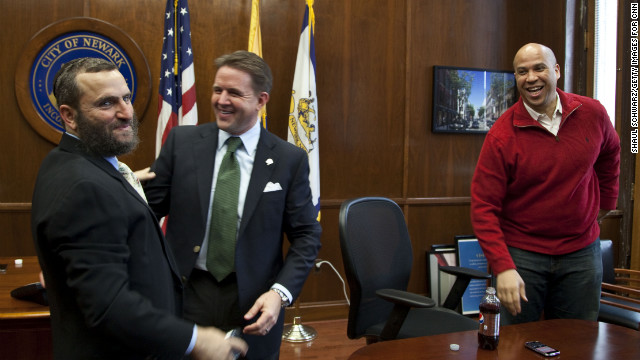
“Jewish time is even worse than black time,” he says, “although I should never drag all the Jewish people down with Shmuley.” And then, about the other guy: “I thought Mormons were always 15 minutes early?”
If the friendship between these men – a black Christian mayor, a rabbi running for Congress and a Mormon university president – wasn't so real, this would sound like a bad joke. Instead, it’s a reflection of how three men from profoundly different backgrounds met 20 years ago, connected and changed one another.
So when this unusual trio got together for a rare meeting this spring, we jumped at the chance to join them.
But before the others arrive, let’s introduce the players.
There’s Booker, the 43-year-old Democratic mayor of Newark, a rising political star and headline grabber, a man who was recently lauded for saving a neighbor from a burning building and grilled for his perceived off-message remarks on a Sunday talk show. He was raised by parents who fought in the courts to integrate the northern New Jersey suburbs where he grew up.
 Mayor Cory Booker takes a break on a Sunday from running Newark to dish about his old friends – two men from profoundly different backgrounds. (Shaul Schwarz/Getty Images for CNN)
Rabbi Shmuley Boteach, 45, is a TV personality, former radio host, prolific author - his books include “Kosher Sex” and “Kosher Jesus” - and now Republican congressional candidate in New Jersey. He was also an unofficial spiritual adviser to Michael Jackson. He was raised by a single mom in Miami.
And Michael Benson, a 47-year-old political scientist and president of Southern Utah University, comes from Mormon and Utah royalty, of sorts. His grandfather is the late Ezra Taft Benson, secretary of agriculture under President Dwight D. Eisenhower and the 13th prophet and president of The Church of Jesus Christ of Latter-day Saints.
With his wife and two young children in tow, the Mormon shows up first.
“Brother Benson,” Booker booms, addressing his friend in Mormon-speak as he stands to give him a big hug.
The last time these two had seen each other was five years ago, when they both helped celebrate the rabbi’s 40th birthday in New York. The massive party, as described by the mayor, was “a mosh pit of yarmulkes and sweat.”
Boteach, who lives in New Jersey and sees the mayor often, rushes into the room on this Sunday a half-hour late.
“Let the record reflect, the Mormon got me lost,” he says by way of hello. The rabbi then glances down at Benson’s two little ones, who sweetly peer up at him.
“They’re a little too Mormon perfect,” he quips. “When Mormons walk into a hurricane, does their hair move?”
Booker, whose nearby desk features a stack of religious texts including the Bhagavad Gita and the Quran, watches as a crowd streams in behind Boteach. The mayor has box seats for this afternoon’s Cirque du Soleil performance of “Michael Jackson The Immortal World Tour,” and he wants his friends and their families to join him. But first he demands to know of the rabbi, “How many people are with you? … They just multiply.”
“Are you kidding?” Boteach shoots back. “We have 30 kids.” Actually, he only has nine.
 Long before he became an author, TV personality and now congressional candidate, Rabbi Shmuley Boteach ran a popular student organization at Oxford University, which is where he met Benson and Booker. (Shaul Schwarz/Getty Images for CNN)
The first one to arrive at Oxford was Boteach, in 1988. His official mission was to serve as a rabbi to the students, but by 1990 he’d broadened his outreach by establishing the all-inclusive L’Chaim Society, a campus organization to promote the universal values of Judaism while celebrating differences. The society, whose Hebrew name means “To Life,” became the second largest student group on campus, surging to 5,000 members – no more than 800 of them Jewish.
The Mormon arrived in 1991, having spent six months in Israel at the Brigham Young University Jerusalem Center. Benson, who earned a doctorate at Oxford, would write his dissertation on President Harry S. Truman and eventually write a book about the Jewish influences in Truman's life and his contributions to Israel’s founding. (The “Mormon perfect” son in the mayor’s office, it turns out, is named Truman.)
Shortly after Benson arrived at Oxford, a Jewish friend told him about Boteach, saying, “You have to meet this rabbi.”
Boteach admits his previous impressions of Mormons had been pretty negative. Then Benson walked into the L’Chaim Society – and the rabbi’s life – one Friday evening. “Not a hair was out of place,” a slightly disheveled and wild-bearded Boteach says, remembering when they met. “I was fascinated.”
Benson never budged from his own religious beliefs, but he became a devout member and officer of the L’Chaim Society, which held legendary Friday night dinners.
 Michael Benson, a grandson of the 13th prophet and president of The Church of Jesus Christ of Latter-day Saints, helped change how his friends – and countless others – view Mormons. (Shaul Schwarz/Getty Images for CNN)
Inside, hordes of people – many of them drunk – were dancing around with sacred scrolls containing the first five books of the Hebrew Bible. They were celebrating Simchat Torah, a holiday that marks the end of the annual Torah-reading cycle.
“I felt like I walked into a scene from ‘Yentl,’” Booker says.
Booker would go on to become president of the now-defunct organization, taking on tasks like lighting a Hanukkah menorah with Mikhail Gorbachev when the former Soviet leader visited Oxford.
Like Benson, Booker doesn’t drink; together they became allies as well as teammates. At the end of holidays like Simchat Torah or Purim – another raucous Jewish festival where celebrators often get drunk - they bonded as sober men in the room. They also led the Oxford Blues to win a British collegiate championship.
“I was their mascot,” boasts Boteach, whose friends tower above him.
The rabbi and Mormon say the mayor's humanity and heart inspire them. Booker says these two faithful men taught him to love and respect different religions, while helping him deepen his own beliefs and sense of awe. Likewise, both the mayor and Boteach say Benson changed how they and hundreds of others view Mormons.
Booker has been known to have his driver pull over when he spots young Mormon missionaries walking in pairs. He understands they’re often financially strapped, so he gives them some money for food and thanks them for being in his city.
“That’s something I never would have done if I hadn’t met Mike,” the mayor says.
And Booker certainly wouldn’t have pulled all-nighters studying Jewish texts before meeting Boteach. There’s a tradition, the rabbi explains, for a father to stay up and study the night before his son is circumcised. It was the middle of exams at Oxford when the rabbi first roped Booker in to join him the night before his first son Mendy's circumcision. Boteach came back again 11 years ago after the birth of Yosef, to which Booker responded, “Shmuley, you’re killing me” before he agreed to take part.
But the last time the rabbi issued his all-night study decree, Booker wasn’t having it.
“Forget it. Don’t even ask. I’m running for mayor,” the then-candidate told his friend six years ago, after Dovid Chaim was born. At 1 a.m., though, there was a knock on Boteach’s door. “You have 60 minutes. That’s it,” the mayor said as he rushed inside.
“Cory and I see each other whenever he needs advice,” the rabbi likes to say of Booker. And it's comments like this that prompt the mayor to retort, “He needs to get his head examined by a proctologist.”
 Rabbi Shmuley Boteach rushes in for the reunion, and a hug from Booker, 30 minutes late. Michael Benson looks on, laughing as Boteach blames him, “the Mormon,” for making him late. (Shaul Schwarz/Getty Images for CNN)
Ever since Boteach learned that Benson’s older brother, Pulitzer Prize-winning editorial cartoonist Steve Benson of The Arizona Republic, had shrugged off religion, the rabbi has said he’s on a mission to bring the older Benson back to the LDS Church.
The Mormon can’t help but marvel at the rabbi’s chutzpah, but he’s happy to let him give it his best shot. So far Boteach has only e-mailed with the older Benson, but he looks forward to a face-to-face meeting so he, the Jew, can give the ex-Mormon the proper Latter-day Saint sell.
Boteach has fallen for the national parks of Utah, where the LDS Church is headquartered. He has lectured a handful of times at universities where Benson has been affiliated. Benson has led the way in scrambling to find kosher food for the rabbi before the two have headed out for weekend hikes.
Booker reflects on his old friends and says, “I love the fact that those two have kept such a good friendship. They’re very different. Mike is humble and soft-spoken; Shmuley is loud and bordering on obnoxious.”
Noticing the time, Booker rushes off to squeeze in a meeting before Cirque du Soleil.
The mayor's friends, at home in his office, take their time leaving. They stroll down the empty and echoing hallways toward the exit of Newark City Hall. The Mormon throws his arm around the rabbi's shoulder.
“I have to get back to Utah soon,” Boteach says. “It's been too long.”
“This time, we'll get you baptized,” Benson tells him.
The suggestion of a Mormon conversion, even in jest, might stop other rabbis in their tracks. But Boteach doesn’t skip a beat: “If it'll get me votes, fine.”
Jerusalem of Gold - Yerushalayim shel Zahav -Ofra Haza- with English Lyrics
"Jerusalem of Gold" (Hebrew: ירושלים של זהב, Yerushalayim Shel Zahav) is a popular Israeli song written by Naomi Shemer in 1967. The original song described the Jewish people's 2000-year longing to return to Jerusalem; Shemer added a final verse after the Six-Day War to celebrate Jerusalem's unification under Israeli control.
At that time, the Old City was under Jordanian rule; Jews had been barred from entering, and many holy sites had been desecrated. Only three weeks after the song was published, the Six-Day War broke out. The song was the battle cry and morale booster of the Israeli troops. Shemer even sang it for them before the war and festival, making them among the first in the world to hear it. On 7 June, the Israel Defense Forces captured the eastern part of Jerusalem and the Old City from the Jordanians. When Shemer heard the paratroopers singing "Jerusalem of Gold" at the Western Wall, she wrote a final verse, reversing the phrases of lamentation found in the second verse. The line about shofars sounding from the Temple Mount is a reference to an event that actually took place on 7 June.
This beautiful version is from the late OFRA HAZA.
Chazak Amenu - We stand as one
The stirring original English/Hebrew anthem recorded by over 50 Jewish Music artists including *Abie Rotenberg *Avraham Fried *Avraham Rosenblum of Diaspora *Beat'achon *Blue Fringe *Bsamim *C Lanzbom *The Chevra *Dan Nichols of Eighteen *David Ross *Dov Levine *Dudu Fisher *Eli Gerstner *Elli Kranzler of Dveykus *Gershon Veroba *Gili Houpt of Remez *Hamsa Boys *Ira Heller *Joe Black *Kenny Karen *Kol Achai *Kol B'seder: Jeff Klepper Dan Freelander *Kol Zimra *Lenny Solomon of Shlock Rock *Lev Tahor *Mah Tovu *Matt Turk *Mayer Davis *Michael HarPaz *Michael Ian Elias *Neshoma Orchestra *Noah Solomon of Soul Farm *Nochum Stark *Ophie Nat *Paul Zim *Rick Recht *Safam *Sam Glaser *Sandy Shmuely *Sean Altman *Shloime Dachs *Shlomo Simcha *Shoresh *Steve Dropkin *Yehuda! *Yehuda Glantz *Yehuda Solomon and The Moshav Band *Yehudah Katz and Reva L'sheva *Yishay Lapidot of Oif Simchas *Yisroel Williger *Yom Hadash *Yossi Green *Yosi Piamenta Another highlight is "Shir Lismoach (Malki's Song)," written by 15 year old Malki Roth just months before she was killed in the Jerusalem Sbarro restaurant bombing.
A terrorist wedding
 Terrorists Ahlam and Nizar Tamimi were married this past week in a ceremony that was broadcast throughout the Arab world. Arnold and Frimet Roth, whose daughter Malki's murder was planned and facilitated by Ahlam Tamimi at Sbarro's in Jerusalem, are furious.
Disgraceful, isn't it?Here's our request. If you have Hebrew speaking friends or acquaintances who you feel should become aware of what has taken place in this sad and worrying extended affair, please point them to today's article in Haaretz -נדיבים לרוצחים. For your English-speaking friends, please refer them to the English version of the same article (here on our blog). We have nothing more than this to ask. People should simply know. [The English article is alsohere. CiJ].
And please also mention to those friends that the two convicted terrorist/murderers about whom Frimet writes were married in a highly-publicized wedding ceremony (including live TV coverage - this was a major event in the Arab world) in Amman, Jordan, on June 16. As far as we can tell, not a single Israeli news source has reported this until now.
A snapshot of the blissful couple, one of many such pictures to appear in the Arab media, appears at the top of this blog posting.

Egyptian Beats Pregnant Wife to Death For Not Voting for Mursi An Egyptian plumber beat his wife to death upon learning that she had not voted for Muslim Brotherhood candidate Mohammed Mursi.
An Egyptian plumber in Alexandria beat his pregnant wife to death upon learning that she had not voted for Muslim Brotherhood presidential candidate Mohammed Mursi, the Egyptian daily al-Wafd reported on Sunday.
According to police reports, the initial argument between the unnamed couple escalated into a violent death, despite the pleas of the battered and bruised wife. She was reported to have died at the hospital from injuriessustained.
Domestic fights have dominated Egyptian news headlines when the bid fell on the two most feared and most controversial candidates, Mursi and former prime minister Ahmed Shafiq, Al-Arabiya news reported.
According to police reports, the initial argument between the unnamed couple escalated into a violent death, despite the pleas of the battered and bruised wife. She was reported to have died at the hospital from injuriessustained.
Domestic fights have dominated Egyptian news headlines when the bid fell on the two most feared and most controversial candidates, Mursi and former prime minister Ahmed Shafiq, Al-Arabiya news reported.
Mohammed Morsi was declared the winner in Egypt's first free presidential election in history by the country's elections commission on Sunday.
In his first televised speech on state TV, Morsi pledged Sunday to preserve Egypt's international accords, alluding reference to the peace deal with Israel.
Prime Minister Binyamin Netanyahu issued an official reaction to Mursi’s victory saying, "Israel appreciates the democratic process in Egypt and respects its results," said Netanyahu.
Jerusalem - Peres Hails Red Army In Ceremony Attended By Putin

Jerusalem - President Shimon Peres hailed the Russian triumph over the Nazis at a ceremony attended by Russian President Vladimir Putin.
"Without the Red Army victory it is unclear if we would be able to meet here as a free people," he said." During the ceremony in Netanya, the two presidents inaugurated a monument commemorating the Red Army's triumph over Nazi Germany. Prime Minister Binyamin Netanyahu, who was originally scheduled to attend the ceremony, has canceled because of his broken leg and will meet Putin in Jerusalem.

"You came at the right time, with the right attitude. Thank you, and welcome to Israel," he said, adding "Spasiba" (thank you) in Russian.
Putin also spoke at the ceremony, thanking Israel for welcoming him and for its honoring of the Red Army.

Putin is scheduled to hold a lengthy meeting with Netanyahu this afternoon – a one-on-one discussion followed by a larger meeting with staff and other ministers – the bulk of the visit will be symbolic: the dedication of a monument to the Red Army for its victory over Nazi Germany, a state dinner with President Shimon Peres and a visit to Bethlehem.
The focus of the Netanyahu- Putin talks is expected to be on Iran and Syria, where the two countries have wide differences of opinion.
Putin, who was met at the airport in the morning by Foreign Minister Avigdor Liberman, was accompanied by some 400 people, flying in on four different planes. The massive entourage includes Putin’s staff, a large number of businesspeople and around 60 journalists.
On Tuesday the Russian president will go to Bethlehem and dedicate a Russian cultural center, and from there to the Allenby Bridge and Jordan for a meeting with King Abdullah, before flying home.
Meretz announced Monday that activists will hold a demonstration outside Netanyahu's residence in Jerusalem while he hosts the visiting Russian president. Meretz MK Zehava Gal-On is expected to be among the participants of the demonstration.
Former Meretz MK Mossi Raz, who initiated the protest, stated "Meretz calls on the prime minister not to meet with Putin until he stops providing assistance to [Syrian President Bashar] Assad to kill his own people."
He added: "Russia stands today as the main block preventing the international community from intervening in Syria. Putin, who sells weapons to Assad that are in turn used to massacre civilians, has blood on his hands. Meeting with him is a moral disgrace and a political blunder."
Friday, June 22, 2012
Faithful and Fortified Volume 3 Trailer
the Rebbe’s relationships with five of Israel’s heads-of-state.
The DVD pulls back the curtain, telling the inside story of the Rebbe’s involvement in Israel’s security, as told by the Prime Ministers themselves, accompanied by behind-the-scenes testimony of their senior aides and advisors. Newly discovered recordings, accompanied by electrifying talks of the Rebbe about the geopolitics of the Middle East round out the nearly 2-hour production.
In a coincidence that can only be called providential, the film – which was two years in the making – presents a talk by the Rebbe which ties directly to today’s headlines. In an address presented in the film, the Rebbe warns of the dangers of Israel’s peace agreement with Egypt, which depends only on the mood of Egypt’s rulers – a mood which can turn, “in an instant.”
The interviews and the release of Faithful and Fortified III – The Prime Ministers was funded by a generous grant from Rabbi Yossel Gutnick.
Astonishing Footage Of Jerusalem Day Prayer, Song And Blessings On The Temple Mount!
For the first time in many years, a large gathering of Jews were able to pray, sing and say blessings while on the Temple Mount, unhindered by nearby police. The contingent of Jewish worshipers was led by Knesset members Michael Ben Ari and Uri Ariel, as well as Rabbi Yisrael Ariel, founder of the Temple Institute, and other prominent rabbis and public figures.
Rabbi Ariel, who was among the Israeli paratroopers who liberated the Temple Mount in the Six Day War, can be heard saying, "I have waited forty five years to be able to say the shehechianu, (blessing of thanks), here on the Temple Mount."
In addition to prayer, song and blessings, a number of worshipers performed the commandment of hishtachavia (prostration), which applies to the Temple Mount.
The group was accompanied by journalists and cameramen representing Israel's major news outlets. The worshipers exited the Mount in song. No violence or protest occurred.


Life magazine argues against a Jewish state, 1946
This is an earnest editorial published in Life in August, 1946, urging that Jewish refugees not be settled in Palestine (mostly because it would upset the Arabs.)
Other notable parts of the editorial are the perfect belief in the conventional wisdom of the day:
- There is no way that Palestine can absorb so many people;
- The Jewish lobby is pushing Truman to do things thatare against American interests;
- The Middle East is not an American interest anyway;
- The reasons the Arabs hated the Jews of Palestine is because of their higher standards of living;
- Nationalism, at least in the case of Jewish nationalism, is wrong.
The most amazing part is the conclusion, where the editors of Life say that rather than create a Jewish homeland where Jews can live in safety, we should instead push for a utopian world where there is no discrimination, so Jews can feel free to live anywhere.
Except Palestine!
When you read reasonable-sounding editorials today spouting what passes for conventional wisdom and coming to conclusions based on them, keep in mind how wrong the accepted facts can be to begin with.
In a World unutterably wearied of seeing people pushed around, there is an understandable, though wishful, tendency to believe in some easy solution for the problem of Europe’s homeless Jews. The notion is being broadcast that the solution is merely to let 100,000 more Jews into Palestine where they can be cared for by their own people. Thus they would be lifted from the world conscience. lt is also suggested that in a true, independent Jewish state, not just a "Home,” the Children of Israel would continue to build out of arid wastes a land of hydroelectric milk and industrial honey so rich and so charming as to attract and provide for all unwanted Jews.
The Zionists are superb organizers; they are also religious idealists, with all the virtues - and_°someof the blind spots—-of zealots through-out history. It could only he wished they had the right answers. But they haven’t.
lt is hard to say this, not only because of the immense humanitarian efforts of the Zionists but also because the situation is so tense and so full of domestic and international emotions and bitterness that it has almost become impossible to express an honest, dispassionate opinion. Yet the time has plainly come for some blunt
American speaking. The U.S. must adopt a Palestine policy and hold to it.
...The difficulty the Jews face, both as to immediate immigration and as to the long-range dream of a homeland, is primarily with the Arabs. Specifically it is with the l,000,000 Arabs in Palestine, hut generally it is with the 50,000,000 Arab population of the Middle East, now banded together in the Arab League and threatening that if they fail to obtain justiee in London they will turn to Moscow.
The differences between the Jews and the Arabs are such they can scarcely be understood unless one is an Arab or a Jew. The present obvious nub of friction is simply that the Jews in Palestine have come to enjoy a much higher standard of living than their Arab neighbors.
This View of the matter was reaffirmed only last spring hy the Anglo-American Committee of Inquiry as a part of its long report on Palestine. This report also urged that l00,000 of the Jews currently in assembly camps in Germany and Austria—and most of them in or trying to get into the American zones-—should be immediately and humanely transported to Palestine.
The Arabs’ response was such that Britain’s Foreign Minister Ernest Bevin estimated that it would require dispatch of a British division and expenditure of $800,000,000 to effect the immigration. So he rejected the proposal.
When President Truman insists, in the face of British objections, that the 100.000 Jews be let in at once, he may have a nervous eye on the Jewish vote. But the President should approach it with the same bipartisan strategy he employed when the United Nations was organized at San Francisco. Otherwise the Palestine question, by becoming the price of a Zionist-led Jewish vote, could enter our politics in such a way that an entire national election might turn on how a few New Yorkers feel about an entirely extraneous issue. That wouldn't go down so well in Oklahoma.
...Britain and Zion are virtually at war today. Yet the Zionists must realize that the British, through the years, have been their truest friends and that removal of the Tommies now would probably tesult in the Arabs quickly pushing the Jews into the sea. This is what spoils the analogy between modern Palesttine and the Ireland of 25 years ago.
...It is clear that the immigration of the 100,000 Jews still in camp cannot really be decided until the central problem of Palestine's future is answered. To admit 100.000 more Jews - almost one fifth of the total Jews already there- without provision for land and industrial expansion to take care of them would only tend
to ghetto-ize the Jewish community. So, what of a Jewish state’? The Arabs regard it as an "exotic movement. internationally financed, artificially stimulated, holding no hope of ultimale or permanent sueeess.” Unfortunately there is something to this point of view. Palestine is not self-supporting. Perhaps given land expansion. great power and irrigation projects and, above all, internal peace, the Jewish community might become self-supporting in a generation or two. That is a moot point and almost irrelevant, because prospects for such expansion, projects and even peace are slight.
Aside, however, from the physical limitations, there is the higher moral question that divides the Jews themselves: namely, is religious nationalism any more the answer to the over-all Jewish problem than is any other sort of nationalism the answer to any part of the world problem?
What the Jews really need is not a national state but the right sort of world. Probably there will always be a certain number of Jews who prefer segregation in the Holy land, but we hazard the opinion that it the nations carried out that provision in the United Nations Charter, presumably not lightly adopted, for "universal respect for, and observance of, human rights and fundamental freedoms for all without distinction as to race, sex, language or religion,” it would do far more to solve the Jewish problem than any multiplication of the Jewish population in Palestine.
Among other things this would mean the re-establishment of the 100,000 Jews in the assembly camps on the same basis, and with the same regard, as the resettlement of all of Europe's millions of displaced persons. If the remnants of Hitler's evil anti-Semitic brew precludes this in Eastern and Central Europe. then, assuredly, humanitarian gates must he opened. but not only in Palestine. The whole world must share the task. including the US.
This makes a bipartisan approach to the problem all the more desirable.
All this—a humane world and one in which a Jew ean live and prosper equally with all—is an easy solution, surely. It is only as hard as the human heart.
We are a selfish people
 Any of you who has read this blog for some period of time has seen me use the term NotInMyBackYard, which basically means that if it doesn't affect me personally, I don't care about it. For example, if bombs are going off in Sderot, none of the elites need to care because Tel Aviv is quiet. I have a friend who has a neat name for this kind of behavior - Bishvili Nivra HaOlam syndrome. The name is a takeoff on the Talmudic saying that every person must think that Bishvili Nivra HaOlam, the world was worthy of being created for me. Of course, the Talmud did not intend to say that the world is for me to the exclusion of everyone else.
As a people, we Israeli Jews are afflicted with Bishvili Nivra HaOlamsyndrome. We don't timely pay our employees or contractors, we cheat on taxes, we cut in lines at banks and supermarkets, we drive like there are no other cars on the road even in the heaviest of traffic (and especially at night when there seems to be less chance of being caught), we remain indifferent to others' pain.... You all know that at least some of those things describe you... and me to a greater or lesser extent.
Eight months ago, the entire country was endangered to resolve a personal issue belonging to one family that was capable of resolution in other ways. Over 1,000 'Palestinian' terrorists were released in exchange for one kidnapped IDF soldier, Gilad Shalit. What was most striking about the release was the manner in which the families of terror victims were completely ignored. Victim impact statements were nowhere to be found. In fact, families of terror victims were unable to even obtain the most basic information from the government. It was as if they did not exist.
I've known Arnold Roth for about eight years - we were briefly colleagues at the same law firm. My eldest daughter was a couple of years ahead of his daughter, Malki HY"D (May God Avenge her blood) in school. Malki was one of 15 (really 16 - one woman remains in a coma to this day) people murdered at Sbarro's here in Jerusalem ten years ago. The planner of that attack, the woman who brought the bomber into Jerusalem, dropped him off outside the restaurant and then went back to Ramallah to gleefully broadcast the story on the evening news, was Ahlam Tamimi. Tamimi, who was released as part of the Shalit deal despite vehement protests from the Roth's and from many other people, is such a sadistic personality that she smiled with satisfaction at the television cameraswhen she was told in an interview that eight of the dead were children, and not three as she thought. She is a despicable excuse for a member of the human race.
Eleven days ago, in a move that is simply inexplicable, because it was not part of the Shalit deal, Tamimi's cousin Nizar Tamimi, who is also a murderer who was released as part of the Shalit deal, was allowed to move to Jordan to marry Ahlam, so long as he doesn't return to Israel or Judea and Samaria for five years. Once again, the government moved without consulting with either Nizar's or Ahlam's victims, thereby ensuring the perpetuation of a prominent terrorist family for at least another generation. When one compares this to the pitched battle the government fought to prevent Yigal Amir, the alleged assassin of Yitzchak Rabin z"l (of blessed memory), from consummating his marriage, the contrast could not be more striking. That's because Rabin was 'one of us' and Arnold and Frimet Roth, as immigrants from Australia and the United States, respectively, are not. But what's most striking about the Roths' battle to at least keep Tamimi in jail, or to keep her from procreating, is not that the government has not acceded to any of the Roth's requests, but that they have not even been willing to listen to them.
The article linked below, authored by Ben Cohen of Joint Media News Service, currently appears on the web editions of the Canadian Jewish News and of Algemeiner Journal. It describes the Roths' ongoing battle to force Tamimi to pay a price for her crimes. You can also read it here. I urge you all to read it.
'We do not sanctify death' Professor Asa Kasher, who authored the IDF's Code of Ethics, says it is no longer necessary to use Trumpeldor's famous dictum "It's good to die for your country" • A frank conversation with the man who keeps a close watch on our national moral compass.

“I like official Israeli philosophy,” says Asa Kasher. “I come from the country’s founding generation. The story of establishing the country is on my shoulders too. My work is to give the country a face from an official standpoint, to examine how the state that belongs to the Jewish nation can be fulfilled in the most proper way, in such a way that the people who work with me and listen to me will have no clue as to my political views. I tell a soldier with left-wing views who refuses to protect the settlements that such a thing is out of the question in a democracy. I also tell a religious soldier who refuses to take part in disengagement that such a thing is out of the question in a democracy. I’d be in terrible trouble if I expressed myself in a way that allowed one of them to say that he knew my opinion on the issue.”
In all of his positions as Israel’s supreme moral authority, in committees and papers and essays, in the writing of ethical codes and pre-legislation recommendations, Professor Asa Kasher keeps up an unbreakable official front. Nobody knows what his politics are. There are dilemmas on the scales all the time: a kidnapped soldier versus the price of his release; a firefighter who was killed during the fire on Mount Carmel versus a fallen Israel Defense Forces soldier; a terminal patient versus a patient awaiting an organ transplant. Israeli society, sensitive and complex as it is, gives rise to hundreds of impossible, heartbreaking questions of ethics. When a decision is required, Asa Kasher is the one they ask.
Kasher, an Israel Prize laureate in philosophy, is considered the foremost philosopher in Israel and a supreme professional authority in the field of ethics. Some say that he is the most respected moral authority of our generation. Besides his work in academia as a world-renowned expert in linguistics, he was the chairman of several important public committees and serves on several others. He also became known as the conscience of the security establishment after he wrote the IDF’s code of ethics. His writings about medical ethics, media and science are considered milestones. Yet despite all his frenetic public activity, he hardly appears in the media.
“We could not keep doing that”
Kasher also served on the Shamgar Committee regarding negotiating a ransom for kidnapped soldiers. The committee members — retired judge Meir Shamgar, Maj. Gen. (res.) Amos Yaron and Professor Kasher — examined the issue for about two years, and at the beginning of this year they submitted their conclusions to Defense Minister Ehud Barak. The report, which was submitted after the release of Gilad Shalit, contained recommendations from that transaction and was classified “top secret.” The press published tiny bits of information about the conclusions, including a recommendation that only a few security prisoners be released in exchange for a kidnapped soldier and that a tough stance be adopted in any future negotiations.
Kasher cannot talk about the details of the report. Nevertheless, he says, “The price of sending terrorists back is not a matter of national honor but rather a question of security and justice. When we look at the list of those who were released in the Shalit deal, where they were released to and the restrictions that were imposed upon them, no danger to security has been created. Yes, justice was compromised, but there was no alternative. After all, we will not leave a soldier in that kind of situation merely to protect justice.
“The families of the victims of the murderers who were released should have been treated with kid gloves. They should have been told before the fact, and not by the media. The authorities should have given them psychological therapy and a listening, sensitive ear.”
Q. Since the Jibril deal, Israel has been paying increasingly high ransoms for kidnapped soldiers. Is this bankruptcy?
“The very fact that the Shamgar Committee was appointed is a statement that we could not keep doing that.”
Q. In the context of preventing kidnappings, the “Hannibal order” — preventing a kidnapping even at the price of harming a soldier — has been discussed quite a bit.
“There is a common error, as though an order existed to shoot a soldier who had been kidnapped, deliberately, because ‘a dead soldier is better than a kidnapped soldier.’ The Hannibal order says that when there is an attempt to kidnap a soldier, it must be prevented by an order to open fire in order to get the soldier back home safe and sound. The kidnappers, not the soldier, are fired upon, even if the soldier’s life is put in some danger. If the soldier is in certain danger — for example, firing an artillery shell at the kidnappers’ car — it’s not allowed. I’m glad that the twisted idea of this procedure that exists in the soldiers’ minds never actually happened. The order has been invoked several times already, and there has never been a case in which any soldiers killed another soldier in order to prevent him from being kidnapped.
“There is a distortion of thought that says that while the state must pay a high price for a kidnapped soldier, Israeli society is willing to accept a dead soldier. This is a scandalous and false idea. Would you be willing to take responsibility for a soldier that you killed? I heard this twisted interpretation for the first time in 1995. I raised an outcry, and I tell you that the damage that the state would suffer from a soldier’s death is greater than the damage that it would suffer from negotiating for his release. Don’t help the country by killing a soldier. It would be better for him to be captured by the enemy than killed by you.
“During Operation Cast Lead, I heard commanding officers say, ‘None of our men will be kidnapped.’ That doesn’t just mean be careful. It means kill yourself rather than let it happen. That’s absolutely horrible.”
Q. We all grew up on the idea of “It’s good to die for your country” [words uttered by Joseph Trumpeldor after being mortally wounded during the battle of Tel Hai in 1920].
“We need to fight against that slogan. A soldier must grow up with the idea that it’s bad to die. Sometimes a soldier has to take a risk, and sometimes, when people take risks, they die. Trumpeldor had been wounded at Tel Hai and was lying on a stretcher. When the physician came to him and asked how he was doing, he quoted a Latin saying: ‘Dulce et decorum est pro patria mori’ [It is sweet and honorable to die for one’s country]. He asked immediately afterward to be evacuated to Kfar Giladi for medical treatment. He did not want to die, and he was not glad to die. He was not like the martyrs executed during Roman times, who recited a blessing over the opportunity they had received to die for the sanctification of God’s name.
“The physician who wrote down his memories of Trumpeldor translated his words to the Hebrew phrase that we know today. Except that it’s not good — it’s bad. And it’s not sweet — it’s bitter. There is no such thing as the value of sacrifice. There is value in sticking to the task. If we must, we’ll take a risk. And we’re also allowed to tell others to take a risk. But we do not sanctify death.
“Frightening civilians? Not in the IDF.”
Q. Can the IDF code of ethics undergo changes?
“The code is stable. The more abstract the values are, the less they change. The doctrines can change because we are in new situations all the time. The doctrine of combating terror, which I dealt with together with Maj. Gen. Amos Yadlin, who was the head of the Military Intelligence Directorate, includes a new situation in which terrorists live among civilians. We must free ourselves from the attitude that regards others’ lives with fear and trembling while holding the lives of our own combat soldiers in complete contempt. International law wants to impose a position on us whereby soldiers are a consumable resource and that the lives of enemy civilians must be protected more than the lives of our own combat troops. Bandages are a consumable resource. Water is a consumable resource. Human beings are not.
“If we warned the terrorists’ neighbors to leave the area, in Arabic, in any way — flyers, telephone calls, television broadcasts, a warning noise — and they stay anyway — why are they staying? Because they choose to be human shields for terrorists. I do not want to kill a human being only because he is a human shield, if he is not a threat to me. But should a soldier of mine risk himself for him? Is the blood of a human shield any redder than the blood of my soldier? A soldier has no choice other than to be in Gaza, in that alleyway. But to be sent inside — why? In the battle in Jenin, in the middle of Operation Defensive Shield, the IDF knew that the refugee camp was booby-trapped. But they still insisted on not bombing from the air in order to keep from harming civilians, and they suffered terrible losses. That was a mistake. They should have made an effort to get the civilian population out of the terrorist environment, and then there would have been no need to send in the infantry.”
Q. What about the “neighbor procedure” that the High Court of Justice outlawed?
“If I know that a wanted terrorist is holed up inside a house, I have two options. I can demolish the entire house, causing more damage and more losses, or I can use a relative of the terrorist who will ask him to give himself up, knowing that the terrorist will not shoot his own relative. I need the neighbor not in order to gain a victory, but in order to minimize the damage to soldiers and also to the other side, so that the terrorist’s neighbors, and even the terrorist himself, will not be harmed.
“The High Court’s sweeping prohibition against using the neighbor procedure is a mistake. It should have been permitted in amended form — for example, using the village mukhtar (religious authority), and by consent.”
Q. Is the IDF more ethical today than in the past?
“The IDF is the only army in the world whose code of ethics states that a human being’s life should be valued simply because he is a human being. There is no other army in the world that would accept such an idea, and among us it passed without anybody batting an eyelash. We are improving all the time. An incident such as what happened on Bus 300 could not happen today. Today’s Shin Bet would not go within 10 miles of such a thing.
“On the other hand, army politics have only gotten worse. What does it mean, ‘running’ for the position of chief of staff? In a professional organization, nobody runs for a position. A tradition of transition from the army to politics has been created, and norms from the political world have trickled into the army.”
Q. Would Richard Goldstone agree with you that we have a moral army?
“Goldstone retracted. The Goldstone of after the report is completely different than the Goldstone of the report. The former suffered from sources that were not honest or credible, easily adopted misleading and false reports, including ones from Israeli organizations, and did not give Israel equal time to respond. He began writing the report with pre-conceived assumptions about the manner in which Israel behaves. In the end, he had to admit that the IDF never had a policy of frightening civilians just to frighten them. That’s what the other side does. We are very careful about that.”
“We’re in no danger of assimilation”
It is impossible not to talk about the current burning issue of the infiltrators. “We are responsible for anyone who is here, even if he entered illegally,” Kasher says firmly. “Except for voting, we need to give them all rights and services. There should be no difference between them and me. Yes, I have to bear that burden, to make sure that no pockets of unemployment, disease or lack of education are created. There is no other way. And that’s without even mentioning that the children born here are Israelis in every way.
“I can understand that problems have been created in specific places, so they have to be distributed. At the beginning of the 1970s, when I lived in Germany as a foreign worker, a researcher, my work permit bore a stamp restricting my place of residence to certain quarters, and I was forbidden to live in others. As a Jew, I was very upset. Only afterward, I discovered that the goal was to prevent a concentration of foreigners in a single place. There is a lot of social logic to that.
“I want everyone who is here to be able to apply for status as a permanent resident. Another half-million people will be here? Let them. It doesn’t upset me. In the end, they can bring in cultural wealth, not danger. We are no longer persecuted Jews in exile. We are a massive, dominant, hegemonic majority. There’s no danger of our assimilating with them, but rather of them assimilating with us, if they want to. We’ll receive a lot of cultural benefit in exchange.”
Q. A lot of people in south Tel Aviv wouldn’t agree with you.
“I was invited to lecture at a college in south Tel Aviv. I arrived a half hour early and walked around the area of the Central Bus Station. I discovered an enormous amount of variety, fascinating, very nice, that didn’t look threatening to me. Food and styles of dress from all over the world. People go on safari in Nigeria to see things like this. Here we have something extremely interesting, and we’re recoiling from it in disgust. If Jews were to be treated that way, we would protest, and with good reason. This is about the dignity of human beings. Not human beings who are like me or close to me, but human beings as human beings. Taking skin color into account is such a miserable thing to do.
“If we are sending some of them back to their countries of origin, for example the people from South Sudan, it should be as part of an enormous operation of return, with joy and flag-waving, not like a deportation. No police troops should be sent after them.
“We should have realized that we established a state here that is an economic lure compared with the African continent. For so many years, we have gotten used to lamenting our fate as a poor country that depends on German reparation payments. We never realized that we’ve turned into an economic attraction.”
Q. So should we let the infiltrators keep coming?
“No. We have to establish a border that looks like the border between Mexico and the United States. There they have army patrols, unmanned aerial vehicles, other methods. But those who are here already should be accepted completely. It’s out of the question that we should say that others won’t come here. We can’t speak that way, not as a democratic state and not as a Jewish state.”
Q. What do you think of haredim serving in the army?
“When it comes to haredim serving in the army, like with the infiltrators, we know how to deal with problems on a pinpoint basis and have difficulty making historic moves. Haredi society is at a historic turning point. If there are 6,000 haredim in colleges and 1,000 haredim in the army, that’s a sign that they’re backing down. One step at a time, but in the right direction. Don’t get in the way of it happening. The person in charge of the law department at Ono Academic College is a Ger Hasid, with the socks and all. Men and women are going to college, to the army, to national service. We must understand how difficult it is for them. A forceful solution will only push them backward.
“We have to reward those who integrate into Israeli society, give affirmative action to soldiers who are serving. Even though the Finance Ministry won’t like it, justice and equality obligate us to give a married haredi soldier a full salary. Equality doesn’t mean being identical in every way. We need to take the haredi lifestyle into account.
“At the same time, it would be worthwhile to deal with various kinds of draft evaders. For example, the leniency shown to athletes and singers is outrageous.”
Subscribe to:
Posts (Atom)
